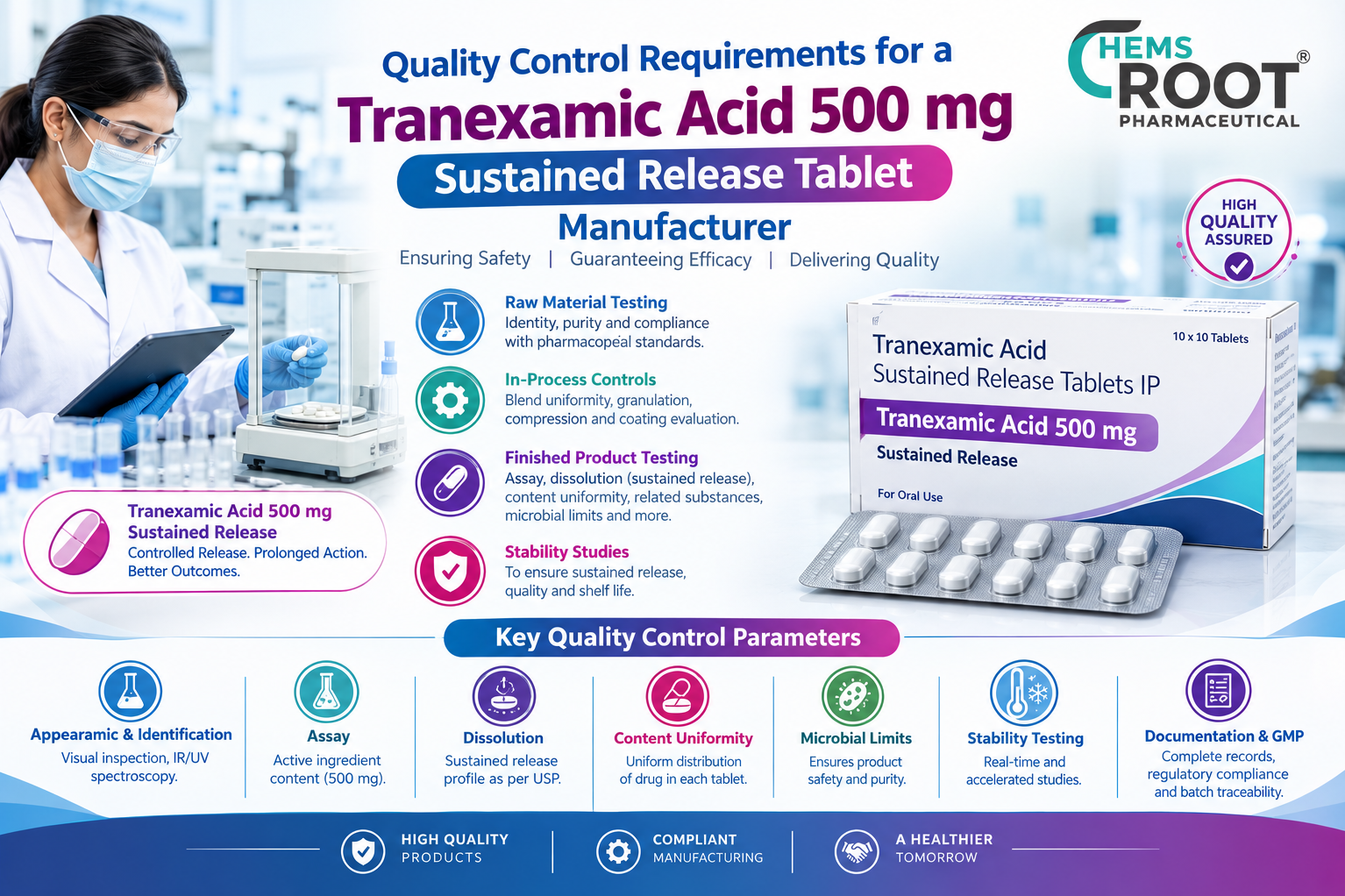
A 500 mg label does not prove that a tablet is sustained release, consistently dosed, or stable in its marketed pack. By the end, you will have a practical checklist for confirming the release design, finished-product specification, analytical methods, process controls, stability evidence, and manufacturer records before approving supply.
Key takeaways
- Confirm the release mechanism, polymer grade, viscosity, and concentration.
- Demand dissolution testing that identifies slow release and dose dumping.
- Review stability data, packaging protection, and chemical-risk controls together.
- Make batch records define testing responsibilities, deviations, and release decisions.
First confirm that the product is genuinely sustained release
A Tranexamic Acid 500 mg sustained release tablet is defensible only when its release mechanism is documented, not when “sustained release” appears on the label. Ask whether it uses a hydrophilic or hydrophobic matrix, the polymer grade and viscosity, polymer concentration, a functional film coating, or another controlled-release system.
Require the target product specification to define:
- Identification, assay limits, dosage-unit uniformity, and related-substance limits
- Appearance, average weight, weight variation, hardness, friability, thickness, and tablet dimensions
- Dissolution or drug-release limits at early, middle, and late time points
Appearance and hardness cannot demonstrate controlled release. A modified-release tablet needs release limits that detect both excessive delay and dose dumping.
Compare the formulation against a suitable reference product or justified development batches across multiple time points:
| Comparison | Evidence required | Failure if absent |
|---|---|---|
| Reference product | Similar release profile using a justified comparison approach | Equivalence remains unsubstantiated |
| Development batches | Profile changes after altering polymer grade or level, particle size, granule size, compression force, coating weight gain, or storage condition | Release mechanism is not understood |
| Final result only | One dissolution value, including 80–85% release | Cannot prove sustained release or rule out dose dumping |
Request data showing each meaningful change shifts release in an understood direction. A single final dissolution result can describe an immediate-release tablet while concealing uncontrolled early release.
Demand a dissolution method that detects both slow release and dose dumping
A finished-product sustained-release dissolution method must name the exact USP apparatus, vessel configuration, medium and volume, temperature, agitation speed, sampling times, filtration, sample replacement, and analytical method. State product-specific acceptance limits at early, middle, and late points; a final percentage alone cannot reveal dose dumping or failure to release Tranexamic Acid.
- Require HPLC validation or validation of another qualified method, identifying the detector, column or separation principle, standard preparation, calculation, system-suitability criteria, and acceptance criteria. The method must demonstrate specificity and linearity against placebo, excipients, and degradation products, plus precision at each time point, accuracy, range, and solution stability.
- Require robustness studies covering agitation speed, medium composition, deaeration, temperature, sampling time, and filtration. The procedure must suit the tablet’s matrix or functional coating and detect both excessive release and incomplete release.
- For every change to polymer grade or level, granulation, compression, coating, manufacturing site, or packaging, compare pre-change and post-change dissolution profiles using the same validated conditions.
| Release stage | What it must detect | Required specification |
|---|---|---|
| Early | Dose dumping or excessive initial release | Exact NMT limit |
| Middle | Controlled progression through the release curve | Exact range or NLT/NMT limits |
| Late | Failure to release the intended dose | Exact NLT limit and total-release criterion |
Do not accept blank placeholders such as “meets profile.” The approved protocol must contain the numerical limit for each sampling time and justify the profile against development batches or a suitable reference product.
Control the formulation and compression variables that govern release
The release profile stays reproducible only when material properties, processing conditions, and compaction are controlled as one system. For a 500 mg dose, define numerical operating ranges and link each range to assay, dosage-unit uniformity, and dissolution.
1. Qualify Tranexamic Acid particle-size distribution and moisture content. Differences in density, particle size, flow, vibration, transfer height, or hopper residence time can segregate the dose before compression.
2. Specify the polymer grade, viscosity range, and polymer concentration that form the intended polymer matrix. Control granule-size distribution and granulation endpoint; under- or over-granulation changes porosity and water penetration.
3. Approve the lubricant identity and level, then validate lubricant mixing time. Excess lubricant or prolonged blending can create hydrophobic surfaces and slow release unexpectedly.
4. Set tablet porosity and compression force ranges. Excessive compression force can reduce porosity enough to produce tablets that release too slowly, even when hardness passes.
5. Establish in-process controls for blend uniformity, granulation moisture, lubricant blending, tablet weight, compression force, hardness, friability, thickness, and functional coating weight gain. Each result needs an alert or action limit tied to the release profile.
6. Sample for segregation after blending, during transfer, at hopper discharge, and during compression. A passing composite assay from a few convenient samples does not prove uniformity in a high-dose tablet.
7. Validate representative commercial batches across intended operating ranges and show the effect of each critical variable on assay, dosage-unit uniformity, and dissolution. Three arbitrary batches without process understanding do not demonstrate control.
Verify stability, packaging, and chemical-risk controls together
Assigning a shelf life requires ICH stability testing in the proposed commercial pack, not loose tablets or laboratory containers. Request long-term data at 25°C/60% RH and accelerated data at 40°C/75% RH when those conditions fit the registration strategy, then confirm the applicable ICH guideline and climatic-zone requirement for the destination market.
Accelerated results cannot replace long-term evidence.
- Initial testing, intermediate points where required, and later shelf-life points.
- Assay, identification, degradation products, dissolution-profile change, water uptake, appearance, hardness, friability, and other physical changes.
- Photostability where applicable, plus in-use, transport, and excursion studies when the bottle, blister, desiccant, or export route makes them relevant.
| Pack configuration | Moisture-control question | Qualification evidence |
|---|---|---|
| Alu-alu blister | Does the foil barrier preserve release performance? | Moisture exposure and dissolution data |
| PVC-based blister | Does higher permeability increase water uptake or alter dissolution? | Comparative moisture and stability data |
| Bottle with foil seal | Does the closure maintain barrier performance after opening? | Seal, in-use, and stability data |
| Bottle with desiccant | Does the desiccant capacity protect the matrix through shelf life? | Capacity, replacement, and excursion data |
Packaging qualification must compare the actual foil, closure, bottle, blister, and desiccant configuration.
Request documented risk assessments for elemental impurities, residual solvents, and nitrosamines covering the API, excipients, water, equipment, packaging, recycled solvents, nitrite-containing excipients, amine-containing materials, and cross-contamination. Residual-solvent testing must address API, excipient, granulation, coating, and cleaning inputs. Routine testing follows the evidence-based risk assessment; an unsupported “no risk” declaration proves nothing.
Use the batch dossier to choose a manufacturer and define accountability
Approve a supplier only after the batch dossier proves batch traceability from API and excipient lots through dispensing, granulation, compression, coating, packaging, testing, release, and distribution. A catalogue entry for a conventional Tranexamic Acid 500 mg tablet cannot establish the exact sustained-release formulation or marketed pack.
Request these records before technical approval:
- Approved master formula, batch manufacturing record, packaging record, certificates of analysis, API and excipient lot reconciliation, and independent or periodic API identity, assay, impurity, and water verification.
- Validated assay and dissolution methods, specificity, system-suitability records, process-validation reports, stability commitments, sample-retention terms, and batch-release documentation.
- Deviation logs, out-of-specification investigations, change-control history, complaint files, recall history, and open corrective and preventive actions.
Use a product-quality agreement to assign accountability explicitly.
| Responsibility | Named owner | Evidence to review |
|---|---|---|
| Batch review and release | Quality unit | Signed release record and authorization matrix |
| Changes to formulation, process, site, or pack | Quality unit and buyer | Approved change control and pre-change dissolution comparison |
| Stability programme and commitments | Manufacturer | Protocol, commercial-pack data, pull schedule, and report access |
| Complaints and recall coordination | Manufacturer with buyer notification | Investigation procedure, contact list, and mock-recall or recall records |
For pharmaceutical contract manufacturing or third-party manufacturing, evaluate Chemsroot Pharmaceutical against this evidence rather than product availability alone. Price the testing lead time, retained samples, audit access, export documents, and proof that scale-up or packaging changes preserve the dissolution profile.
Related product
 | Composition-Tranexamic Acid 500mg Tablet View product → |
Frequently asked questions
How can you confirm that a tranexamic acid tablet is genuinely sustained release?
Ask for the documented release mechanism, such as a hydrophilic or hydrophobic matrix, polymer grade and viscosity, polymer concentration, functional film coating, or another controlled-release system.
What dissolution evidence should a manufacturer provide?
Request a validated dissolution method with defined media, apparatus, sampling times, acceptance limits, and evidence that it detects both excessively slow release and dose dumping.
Which formulation and compression variables affect sustained release?
Review polymer type and concentration, excipient ratios, granule properties, tablet hardness, compression force, tablet weight, coating performance, and in-process controls.
What records should you review before choosing a manufacturer?
Examine the batch manufacturing and testing records, dissolution results, stability data, packaging specifications, deviation and change-control records, licences, and clearly assigned release responsibilities.
Keywords