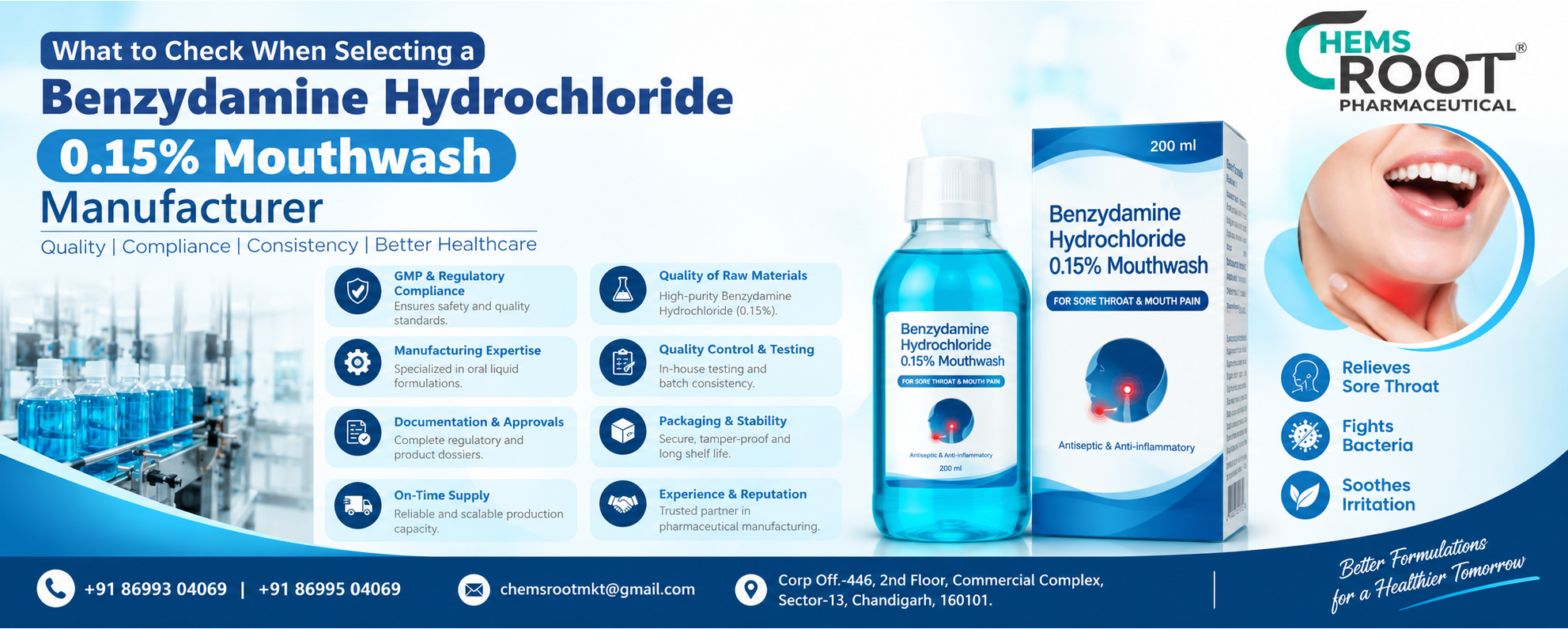
A 0.15 percent label does not prove that an aqueous mouthwash contains the stated strength, remains stable through its shelf life, or meets microbiological and packaging requirements. By checking the formulation basis, pharmacopoeial standard, batch records, finished-product tests, stability evidence, and supplier controls, you can compare manufacturers on evidence rather than sales claims.
Key takeaways
- Specify 0.15% w/v benzydamine hydrochloride, equal to 1.5 mg/mL.
- Request assay results, microbiological tests, and a signed certificate of analysis.
- Check pH, preservative suitability, water quality, and microbial limits.
- Match stability data, packaging, labels, licences, and supply terms to your market.
Confirm the strength, standard, and product specification
The purchase specification must state benzydamine hydrochloride 0.15% w/v, not 0.15% benzydamine base and not 0.15% w/w. For an aqueous mouthwash, this equals 1.5 mg/mL; a 15 mL dose therefore contains 22.5 mg of benzydamine hydrochloride. Require the assay calculation to show this basis explicitly.
Ask the manufacturer to provide:
- The approved product specification naming the active ingredient, dosage form, concentration, acceptable assay range, and calculation basis.
- The raw-material specification and certificate identifying the benzydamine hydrochloride grade and reference standard.
- The finished-product batch record or test report showing the measured assay, not only the target concentration.
- The declared pharmacopoeial reference: IP, BP and Ph. Eur. standards are not interchangeable unless the manufacturer documents equivalence and the selected standard matches the destination market.
Do not approve a batch from the active assay alone. The finished-product specification should also cover identification, related substances or degradation products, pH, appearance, fill volume, viscosity, microbial limits, preservative content when used, and container-closure requirements. A claim that the product is sterile does not replace microbial control for a non-sterile aqueous oral rinse.
Verify that the documents identify the actual manufacturing site and the applicable product registration or licence.
Review the finished-product tests and certificate of analysis
Do not accept a certificate of analysis that reports only assay and microbial results. Require the finished-product specification, the complete batch result, and the release decision for the named manufacturing site.
TestRequire on the reportReject or clarify whenIdentificationConfirm benzydamine hydrochloride in the finished rinseThe test identifies only the flavour or preservativeAssay0.15% w/v, equal to 1.5 mg/mL, with method, limits, result, and unitsIt states 0.15% w/w or benzydamine baseRelated substancesNamed impurities or degradation products, limits, and resultsIt gives no impurity limits or uses “complies” alonepHSpecification range and measured resultThe range is absent or outside the approved specificationAppearance and viscosityDescription, viscosity method, limits, and resultColour, clarity, sediment, or flow differs without investigationFill volumeNominal volume, permitted range, and resultOnly the label claim appearsMicrobial qualityOrganism limits, method, and results for the non-sterile rinseResults are missing or reported without limitsPreservative controlIdentity, concentration, assay, and preservative-effectiveness data when usedPresence in the formula is treated as proof of protectionContainer closureClosure inspection or integrity resultSeal, leakage, or compatibility checks are undocumented
The CoA must show product name, batch number, manufacture and expiry dates, specification version, test methods, individual results, approval status, and the authorised release signatory. Match every detail to the purchase order, batch record, and registered product information.
Assess pH, preservatives, and microbiological control
A preservative on the label does not prove that a water-based mouthwash remains safe through its shelf life. Require the finished-product specification to state microbial limits, including total aerobic microbial count and total yeast and mould count, with any organism-specific tests required by the target pharmacopoeia or registration specification.
Judge pH as a performance parameter, not only a comfort measure. Request the target range, validated test method, permitted drift, and pH trend data from stability batches; pH changes can affect benzydamine stability, preservative activity, flavour, and container compatibility.
If the formula uses a preservative, obtain its identity, concentration, assay method, and results at release and during stability. Require preservative-effectiveness testing on the finished product. Do not accept a claim based only on preservative presence, because dilution, flavour changes, pH drift, or packaging adsorption can reduce protection.
Ask for these records:
- Water-system monitoring results and defined sampling points
- Cleaning-validation evidence for tanks, lines, and filling equipment
- Procedures for investigating out-of-specification microbial results
- Change-control records covering preservative, flavour, bottle resin, closure liner, water system, and analytical method
A sterile-manufacturing claim does not replace control of a non-sterile oral rinse. Reject suppliers that cannot show microbial trends, documented investigations, and preservative or pH control across batches.
Check raw materials, water systems, and manufacturing controls
Evidence of control starts before the assay: require records showing that each ingredient is identified, released, and protected from contamination before compounding. A finished-product certificate alone does not prove this control.
1. Ask for the raw-material specification, certificate of analysis, and raw-material identity testing for benzydamine hydrochloride, preservatives, flavour, and excipients. Confirm approved supplier status, incoming quarantine, sampling, retest dates, and documented supplier qualification.
2. Review purified water records covering system qualification, sanitisation, storage, circulation, sampling points, microbial limits, alert and action levels, and trend reviews. Water results must cover the dates used for your batch.
3. Examine cleaning validation for tanks, transfer lines, filling equipment, and utensils. The report should name residues tested, sampling methods, acceptance limits, and the worst-case product or equipment configuration; otherwise, carryover and microbial contamination can enter the rinse unnoticed.
4. Request the executed batch record, including dispensing checks, line clearance, mixing time, equipment identification, in-process controls, yield reconciliation, and operator sign-offs. Missing entries or unexplained corrections weaken traceability.
Review change-control and deviation records before ordering. The manufacturer must assess changes to suppliers, preservatives, flavour, bottle components, site, water system, or analytical methods, then document comparability, regulatory notification, or new stability work when required. OOS microbial results need a written investigation and corrective action.
Match stability, packaging, and labelling to the target market
A formulation is suitable for your market only when its shelf life, package, and directions are supported for the exact product you will sell. Ask for stability data generated on the commercial flavour, preservative system, bottle, closure, and fill volume—not a similar product.
- Request long-term and accelerated stability results under conditions matching the destination market. For Indian distribution, include the intended climatic zone and high-humidity exposure where relevant; accelerated data alone cannot justify the labelled shelf life.
- If the rinse contains a preservative, verify its identity, concentration, assay through shelf life, and preservative-effectiveness data on the finished product. Dilution, flavour changes, pH drift, or packaging adsorption can reduce protection.
- Confirm the target pH range, validated test method, permitted drift, and stability-batch trends. pH affects benzydamine stability, preservative activity, taste, and package compatibility.
- Require container-closure integrity results and extractables and leachables assessments for the bottle, liner, cap, dosing cup, and label adhesive. Alcohol, flavour oils, surfactants, and acidic systems can damage or contaminate components.
- Obtain market-specific approved artwork showing dose volume, frequency, dilution, expectoration, minimum age, treatment duration, and warnings. Do not reuse generic directions.
Review change-control records before ordering: a resin, closure, flavour, preservative, supplier, site, or test-method change can require comparability work or new stability batches.
Test the supplier’s regulatory and commercial accountability
A traceable PCD or third-party partner can identify the licensed manufacturing site, legal product owner, and person accountable when a batch fails. Request the site’s manufacturing licence, GMP inspection status or latest inspection outcome, product registration or notification for your market, and proof that the named site—not a trader—holds batch-release authority.
Match the certificate of analysis to the batch number, manufacturing date, and site address.
Your agreement should specify:
- Who owns the marketing authorisation or product permission and controls the master formula and artwork.
- Who approves suppliers, packaging changes, manufacturing-site changes, analytical methods, and other change control decisions.
- Who handles complaints, recalls, regulatory responses, and pharmacovigilance, with notification deadlines and retained records.
- How batch traceability works from raw-material receipt through dispatch, including retention samples and recall access.
Use the same document request with Chemsroot Pharmaceutical rather than accepting a catalogue or territorial exclusivity as proof of manufacturing control.
EvidenceTraceable manufacturing partnerTrading intermediarySite complianceLicence and GMP inspection status for the named siteUnrelated ISO certificateBatch accountabilityBatch records, release authority, and traceable COASupplier’s generic paperworkContract responsibilityDefined changes, recalls, complaints, and pharmacovigilance dutiesVerbal assurances or resale terms
Frequently asked questions
- What strength should the purchase specification state?
- State benzydamine hydrochloride 0.15% w/v, equal to 1.5 mg/mL in an aqueous mouthwash. A 15 mL dose contains 22.5 mg of benzydamine hydrochloride.
- Which finished-product tests should you request?
- Request the finished-product specification, assay result, appearance, pH, fill volume, microbiological results, and a signed certificate of analysis for the supplied batch.
- Why do pH and preservatives matter in benzydamine mouthwash?
- pH affects product performance and tolerability, while the preservative system must control microbial growth without compromising compatibility or stability. Review the method, acceptance limits, and supporting data.
- What manufacturing controls should you check?
- Review raw-material specifications, supplier qualification, purified-water testing, equipment cleaning, batch records, in-process checks, and controls preventing mix-ups or contamination.
- What packaging and stability evidence should the manufacturer provide?
- Ask for stability data in the proposed bottle and closure, storage conditions, shelf life, in-use instructions, transport considerations, and labels that meet the target market’s rules.
Keywords