
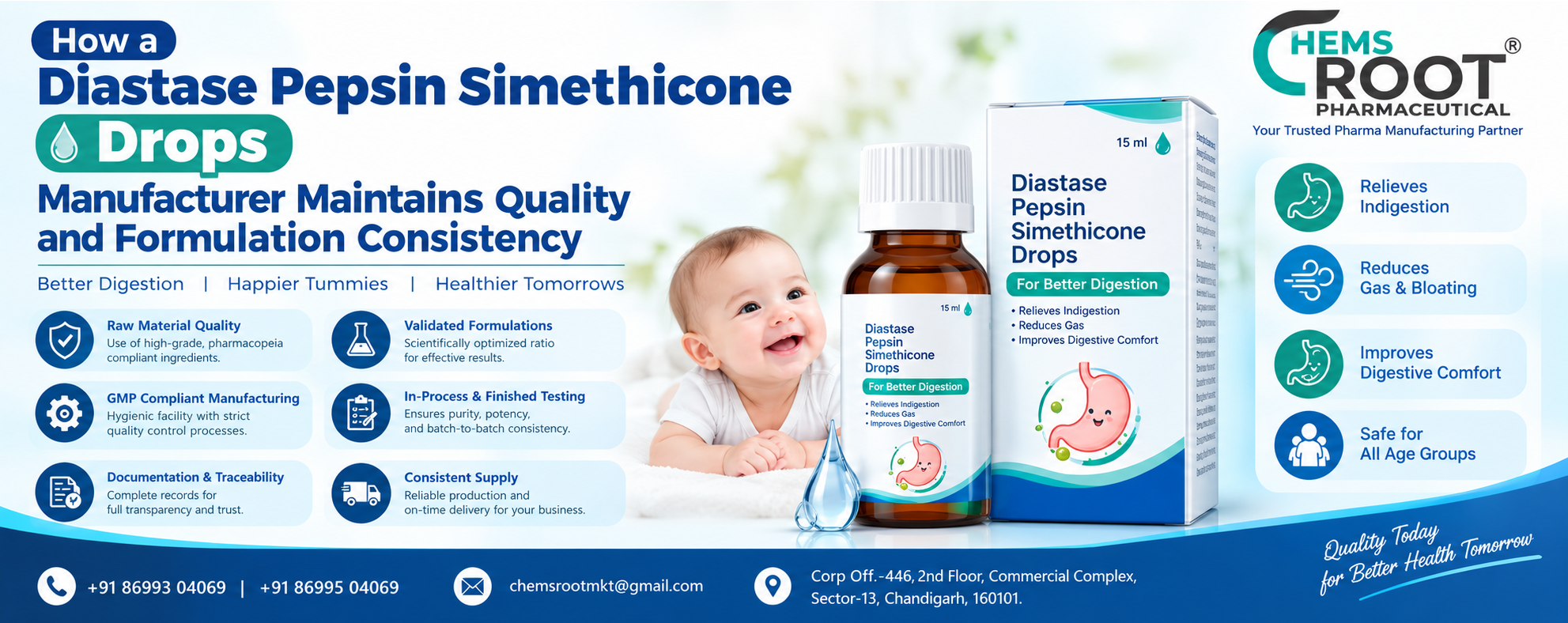
A combined enzyme-and-simethicone drop is not controlled by weighing three active ingredients and checking that the liquid looks uniform. You will be able to assess whether a manufacturer has a credible process by examining activity-based specifications, mixing controls, stability evidence, dispensing performance, and batch documentation.
Key takeaways
- Request the master formula with composition and enzyme activity per millilitre.
- Verify enzyme activity, simethicone content, preservative level, and delivered dose.
- Review stability data from initial testing through the stated expiry date.
- Ask for licences, batch records, certificates of analysis, and product specifications.
Start with the formula the manufacturer can actually document
A defensible formula starts with a controlled master formula, not a product name or a total powder weight. For diastase pepsin simethicone oral drops, it must state the composition per millilitre, including diastase activity units, pepsin activity units, simethicone concentration, vehicle, preservative, flavour, sweetener, colour, and purified water.
The manufacturer should provide evidence that connects the approved formula to an actual batch:
- The master formula and finished-product specification, identifying each ingredient, target quantity, permitted range, and fill volume.
- Diastase and pepsin raw-material specifications stating activity units, assay method, acceptable activity range, moisture limit, microbial limits, and storage conditions.
- Simethicone documentation identifying its grade, concentration, physical form, and required dispersion characteristics.
- Certificates of analysis for each active and excipient lot used in the batch, matched to supplier lot numbers.
- An executed batch manufacturing record showing weighed quantities, equipment, addition sequence, mixing conditions, temperature limits, and hold times.
- A finished-product certificate of analysis reporting enzyme activities, simethicone content or dispersion results, pH, appearance, microbial quality, and fill volume.
The approved formula must also include version control and authorised change history. A document showing only “100 mg enzyme” cannot prove equivalent potency because activity grades differ between suppliers. The batch record and release results must demonstrate that the delivered product matches the specified formula.
Control enzymes, excipients, and the order of addition
Uniformity starts with separate controls for the enzyme concentrates and simethicone, not with a final visual check. Raw-material qualification must confirm diastase and pepsin by activity units and assay method, plus moisture, microbial limits, storage conditions, and an acceptable activity range; “100 mg” alone cannot establish enzyme potency.
Qualify simethicone, preservatives, sweeteners, flavours, colours, and purified water against approved specifications before dispensing.
- Verify each material identity, lot number, status label, and weighed quantity before compounding. Keep enzyme containers closed and protected from excess humidity, heat, and direct light.
- Prepare the simethicone premix with the specified vehicle or wetting medium, using a validated mixing speed and time. This prevents silicone droplets from clumping or floating when added to the main batch.
- Charge purified water and soluble excipients in the documented order, then add the simethicone premix under the defined shear range. Excessive shear can introduce foam; insufficient energy can leave uneven simethicone dispersion.
- Adjust pH within the approved range before adding diastase and pepsin. Add both enzymes only below the validated temperature limit, then mix for the validated time without unnecessary recirculation.
- Deaerate and limit the approved hold time before filling. Record temperature, pH, mixing speed, mixing duration, and hold time as batch-process controls.
Take samples from more than one tank location, and at multiple time points when settling or segregation is credible. Test enzyme activity separately from simethicone dispersion; appearance or total mass cannot reveal localized potency loss or silicone-rich portions.
Use testing that measures both chemistry and delivered dose
A batch passes only when chemical results and actual drops agree. Identity testing confirms diastase, pepsin, simethicone, preservatives, and other critical ingredients; assay measures concentration, while enzyme-activity testing confirms that mass values have not replaced functional potency.
Test stageEvidence requiredWhat a failure meansIn-processpH and viscosity testing, appearance checks, mixing uniformity, and suspension redispersionEnzymes may lose performance, or simethicone may separate and deliver unevenlyFillingFill-volume checks and drop-count or mass-per-drop measurements from the start, middle, and end of the runA compliant formula can still give an incorrect doseFinished productIdentity testing, assay, enzyme activity, microbial limits, pH, viscosity, appearance, and delivered-dose uniformityThe batch cannot demonstrate its labelled composition, safety, or dose consistencyMicrobiologyBioburden controls during manufacture plus finished-product microbial limits testingContamination can survive or multiply in the aqueous, nutrient-containing liquid
The manufacturer should trend assay, enzyme activity, viscosity, microbial results, fill volume, and delivered dose across commercial batches. Process validation is not three passing batches followed by a declaration of consistency; it links critical material attributes and critical process parameters to repeatable results at production scale.
Out-of-specification results require a documented investigation, not selective retesting until a passing value appears. A certificate of analysis supports release, but the underlying batch record, in-process data, and packaging-line reconciliation show whether the reported dose reflects the bottle reaching the patient.
Prove uniformity through the bottle’s full shelf life
A shelf-life claim is credible only when the product is tested in its marketed bottle, closure, dropper, label, and secondary pack—not in a beaker. Run accelerated stability and long-term stability studies at defined storage conditions, then compare results with release specifications at scheduled timepoints.
Track these stability endpoints:
- Diastase and pepsin activity, not only their mass, to reveal potency loss.
- Simethicone distribution, appearance, settling, foam, and redispersibility after storage.
- pH drift, because pH affects enzyme stability, preservative effectiveness, taste, container compatibility, and silicone dispersion.
- Preservative effectiveness through microbial challenge testing, rather than accepting a nominal preservative concentration as proof of protection.
- Water loss, oxygen and moisture transmission, adsorption, extractables, closure fit, and visible container changes.
- Dropper dose uniformity after storage, including the first, middle, and final doses and performance after repeated opening.
The preservative result must reflect the finished aqueous formulation and its use after opening. Partitioning into silicone or oil phases and adsorption to the bottle can reduce protection even when the label concentration remains unchanged.
Treat any supplier, enzyme grade, surfactant, preservative, bottle, dropper, mixing equipment, or process change as a stability question. Recheck activity, dispersion, dose delivery, and shelf life after the change; matching formula percentages does not prove matching performance. A failed trend in pH, potency, microbial protection, or delivered volume requires investigation before release extension.
Request a quality package before approving a manufacturing partner
Do not approve a diastase, pepsin, and simethicone drops order from a certificate alone. Request a quality package that lets you trace one released batch from materials to filled bottles.
1. Ask for the approved specification, supplier-qualification evidence, incoming-lot records, and the batch manufacturing record. The record should show dispensing checks, order of addition, mixing time, shear, temperature, deaeration, hold time, filling, and line clearance.
2. Request the certificate of analysis for a representative finished batch, plus the underlying assay, enzyme-activity, viscosity, microbial, fill-volume, and delivered-dose results. Confirm that sampling covers multiple locations or time points when settling or segregation could affect simethicone dispersion or enzyme concentration.
3. Ask for process validation reports that define critical material attributes, critical process parameters, commercial-scale results, and ongoing trend review. Testing three finished batches without demonstrating control of the process is not sufficient validation.
4. Review deviation reports, out-of-specification investigations, packaging-line reconciliation, retention-sample arrangements, and the change control procedure. Ask how formula, supplier, packaging, process, label, and test-method changes reach you before implementation.
5. Fix export or domestic-market requirements in the technical and quality agreement: pharmacopoeial references, permitted excipients, label language, stability data, release documents, and retention samples.
The same evidence should be requested when evaluating Chemsroot Pharmaceutical, not substituted with a product catalogue or sales quotation. If a manufacturer will not share this package under confidentiality, postpone approval.
Frequently asked questions
- What should a master formula for these oral drops document?
- It should state composition per millilitre, including diastase and pepsin activity units, simethicone concentration, vehicle, preservative, flavour, sweetener, colour, and purified water.
- How does a manufacturer maintain formulation consistency?
- The manufacturer controls raw-material specifications, enzyme potency, excipient quantities, mixing conditions, and the order of addition in the master formula.
- What testing should you request for diastase pepsin simethicone drops?
- Request tests for identity, assay or enzyme activity, simethicone content, pH, appearance, microbial quality, fill volume, and dose uniformity.
- How is shelf-life quality demonstrated?
- Stability studies check the formulation in its final bottle through the labelled shelf life, including potency, appearance, pH, microbial quality, and dose delivery.
- Which documents should you review before approving a manufacturer?
- Request the master formula, product specification, raw-material specifications, batch manufacturing record, certificate of analysis, stability data, licence copies, and deviation or complaint procedures.
Keywords