A bulk order is only as reliable as the specification behind it: “silymarin” can describe different extract strengths, while L-ornithine L-aspartate requires its own identity, assay and moisture controls. By the end, you will have a practical way to compare the formula, qualify the actual manufacturing site, review technical documents and approve the delivered batch.
Key takeaways
- Define both ingredient strengths and silymarin standardisation before comparing prices.
- Ask for raw-material specifications, test methods and laboratory evidence.
- Verify the manufacturing licence, site address and accountable legal entity.
- Require batch release documents, stability data and moisture-control details.
Define the capsule formula before comparing suppliers
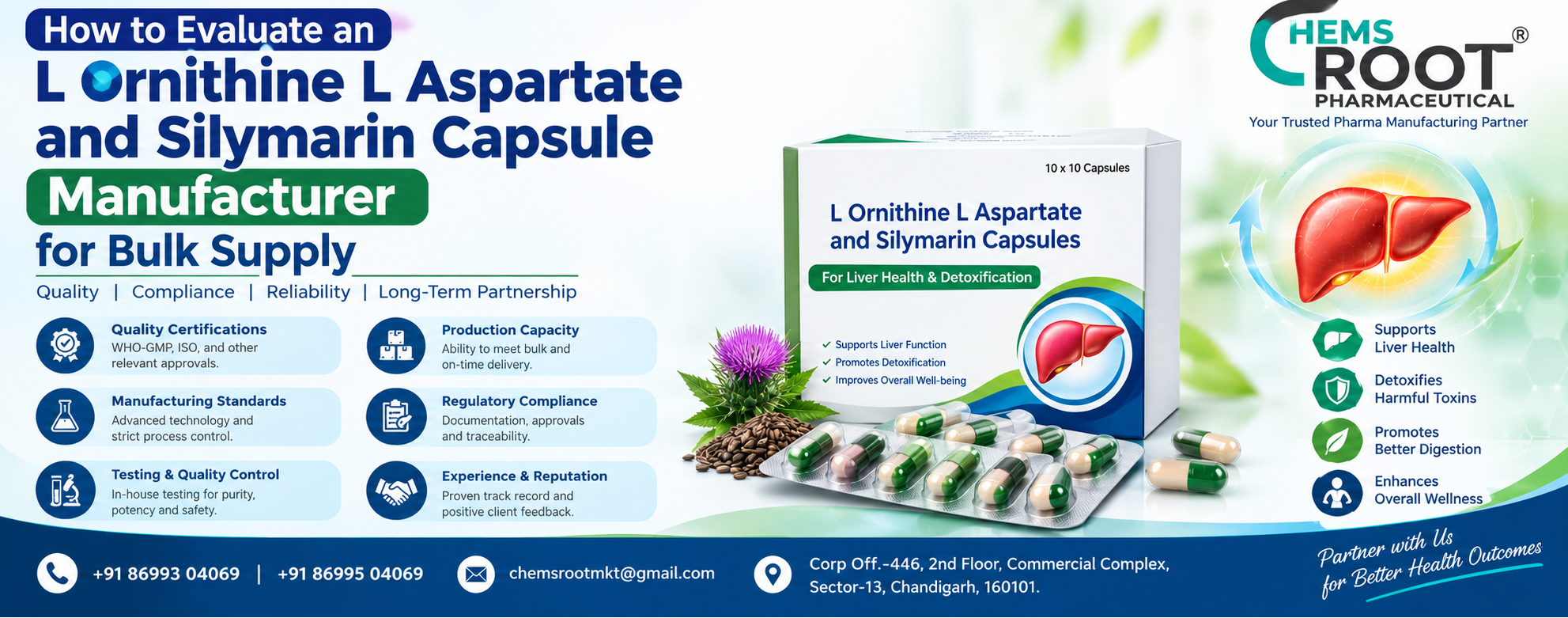
Request a written specification for the L ornithine L aspartate silymarin capsule before requesting a price. Do not compare quotations that use only the product name; a different L-ornithine L-aspartate strength or extract standardisation makes the prices non-comparable.
- State the quantity of L-ornithine L-aspartate per capsule, with assay expressed as ornithine and aspartate content rather than total fill weight.
- State the silymarin quantity, milk-thistle extract ratio, and standardisation, such as 70% or 80% silymarin. Specify whether the label declares total flavonolignans or silybin.
- Name the intended standard: Indian Pharmacopoeia, British Pharmacopoeia, United States Pharmacopeia, or an identified food-supplement specification.
- Specify capsule shell material, colour, size, excipient grades, net fill weight, packaging format, and target shelf life.
- Require assay limits, related-substance limits, water content, residual-solvent limits where relevant, and a validated uniformity-of-dosage-units method with its acceptance criterion.
- Require dissolution conditions: medium, volume, apparatus, agitation rate, sampling times, analytical finish, and method-validation evidence.
Tell each silymarin capsule manufacturer that changes to the extract supplier, solvent, standardisation method, L-ornithine L-aspartate source, shell, excipient, or packaging require formal change control and comparative testing. A matching “silymarin percentage” does not prove matching flavonolignan composition or capsule performance.
Also record who will handle destination-market registration, labelling, complaints, adverse events, and recalls in the bulk pharmaceutical supply contract.
Test whether the raw materials and analytical methods are credible
A credible check starts with traceable raw-material records and test results that identify each active, not a certificate showing only capsule weight. Ask for the supplier’s specification, batch COA, test method, chromatogram and reference-standard details for both ingredients.
For silymarin, require the following before accepting a quotation:
- Botanical identity of the milk-thistle source, plant part, extraction solvent and milk thistle extract ratio
- Silymarin standardization, stating whether the percentage means total flavonolignans or native extract
- HPLC silymarin assay with results for the major flavonolignan profile, not only a single percentage
- Batch-to-batch limits for moisture, residual solvents and relevant contaminants
“140 mg silymarin” is incomplete unless the document states whether it means 140 mg of extract, 140 mg of total flavonolignans or an extract equivalent to a defined quantity of milk-thistle fruit. A changed extract can retain the same headline percentage while producing a different flavonolignan fingerprint.
For L-ornithine L-aspartate, request an L-ornithine L-aspartate identity test based on an orthogonal technique, plus separate assay results for ornithine and aspartate. Check related substances, water and residual solvents when the manufacturing process makes them relevant.
In the finished capsule, require separate validated assays and a uniformity-of-dosage-units test; a passing batch average can hide under-filled capsules. Put any raw-material, solvent, method, excipient or packaging change under formal change control with comparative testing.
Qualify the manufacturing site, licence and accountable legal entity
A distributor’s certificate cannot prove that the named site legally made this combination capsule. Require documents issued to the manufacturing premises, with the legal entity, full address, dosage form, product name and licence validity matching your quotation and purchase contract.
- Obtain a pharmaceutical manufacturer GMP certificate naming the capsule site, inspection authority, scope and expiry date; confirm it with the issuing regulator during manufacturing licence verification.
- Request the site’s manufacturing licence and product permission for the L-ornithine L-aspartate and silymarin capsule, not a licence for syrup, tablets or another company’s premises.
- Match the approved master formula, batch-manufacturing record, change-control procedure and recent certificate of analysis to the proposed strength and pack.
- Review third-party manufacturing documents showing who owns the formula, releases each batch, investigates deviations, handles complaints and authorises recalls.
- Sign a quality agreement pharmaceutical document that assigns those duties, plus registration, pharmacopoeial compliance and country-specific labelling for export orders.
CredentialWhat it provesDisqualifying mismatchSite GMP certificateThe inspected premises operates within the stated GMP scopeCertificate names only a distributor or different addressManufacturing licenceThe regulator permits this site and dosage formLicence covers only syrup or another legal entityProduct permissionThe specific combination is authorised for manufactureSupplier offers only a similar productBatch records and quality agreementResponsibilities and controls are contractually definedNo accountable batch-release signatory
Apply this test to every quotation, including one from Chemsroot Pharmaceutical; the legal name on the quotation, licence, GMP certificate and batch documents must be consistent.
Related product
 Sym L-Omithine L-Aspartate With B-Complex Syrup
Composition-Sym L-Omithine L-Aspartate With B-Complex Syrup
Request the documents that support release of every bulk batch
Release each bulk batch against records from the actual manufacturing site, not a distributor’s file. Before ordering, obtain the site’s GMP certificate, manufacturing licence, quality agreement, approved master formula, change-control procedure and a recent certificate of analysis pharmaceutical record.
Ask the manufacturer to provide these records:
- The approved master formula, showing L-ornithine L-aspartate, silymarin, excipients, target fill weight and manufacturing instructions.
- The finished product specification, including identity, assay for each active, dosage-unit uniformity, disintegration or dissolution, water, microbial limits and packaging checks.
- A representative batch manufacturing record with equipment, yields, in-process tests, deviations and authorised release signatures.
- The change-control procedure, including notification and comparative testing for changes to extract supplier, solvent, standardisation, capsule shell, excipient or packaging.
RecordReview before orderingCheck when the batch arrivesGMP certificate and licenceConfirm the named site and dosage formMatch site, licence details and validityQuality agreementAssign testing, complaints, recalls and release dutiesConfirm the shipped batch follows those dutiesBatch manufacturing recordCheck the proposed process and controlsMatch batch number, dates, quantities and signaturesCertificate of analysisConfirm numerical results, methods and limitsMatch batch number and verify assay, uniformity, disintegration or dissolution, microbial quality and fill weight
Reject a certificate that says only “pass.” Request deviation, out-of-specification and release documentation before accepting the shipment.
Check stability, moisture protection and commercial supply controls
Accept a proposed shelf life only when the supplier provides real-time and accelerated capsule stability data for the exact formulation and commercial packaging. Review separate stability-indicating results for ornithine/aspartate and silymarin, plus dissolution, water content, microbial quality and physical appearance. Accelerated data alone cannot support the full proposed shelf life.
Packaging must be justified in the pharmaceutical packaging specification, not chosen for appearance or lowest cost. Amino-acid salts and dry botanical extracts can absorb moisture differently; moisture uptake can impair powder flow, capsule filling, dissolution and assay stability.
A claim about moisture protection capsules is useful only when supported by data for the bottle or blister, seal and desiccant configuration.
For a practical bulk capsule supplier evaluation, require these controls in the supply agreement:
- A validated uniformity-of-dosage-units method with an acceptance criterion for individual capsules; average assay alone can hide non-uniform fills.
- Formal change control covering the extract supplier, extraction solvent, silymarin standardisation, L-ornithine L-aspartate source, capsule shell, excipient grade and packaging, with comparative testing before approval.
- Batch records and trend data showing consistent ornithine/aspartate content, silymarin assay, related substances, water and residual solvents where relevant.
- Named responsibility for domestic release, complaints, adverse events and recalls; for export, also assign registration, pharmacopoeial compliance, artwork and country-specific labelling.
“Third-party manufacturing” does not prove destination-market authorisation. Confirm the legal entity responsible for each obligation before ordering.
Frequently asked questions
- What should you define before comparing capsule manufacturers?
- Specify the L-ornithine L-aspartate strength, silymarin extract strength and standardisation, capsule shell, pack size, testing requirements and target market.
- How can you test whether raw materials and analytical methods are credible?
- Request raw-material specifications, certificates of analysis, identity and assay methods, reference standards, method validation data and results from an independent or qualified laboratory.
- Which manufacturing-site details should you verify?
- Check the site address, manufacturing licence number, dosage-form approval, inspection status and the legal entity named on the licence, quotation and quality documents.
- Which documents support release of each bulk batch?
- Request the batch manufacturing record, certificate of analysis, finished-product test results, packaging records, deviation report and authorised quality-release approval.
- What supply controls matter for this capsule?
- Review stability data, expiry dating, storage conditions, moisture-barrier packaging, transport controls, minimum order quantities, lead times and change-notification procedures.
Keywords