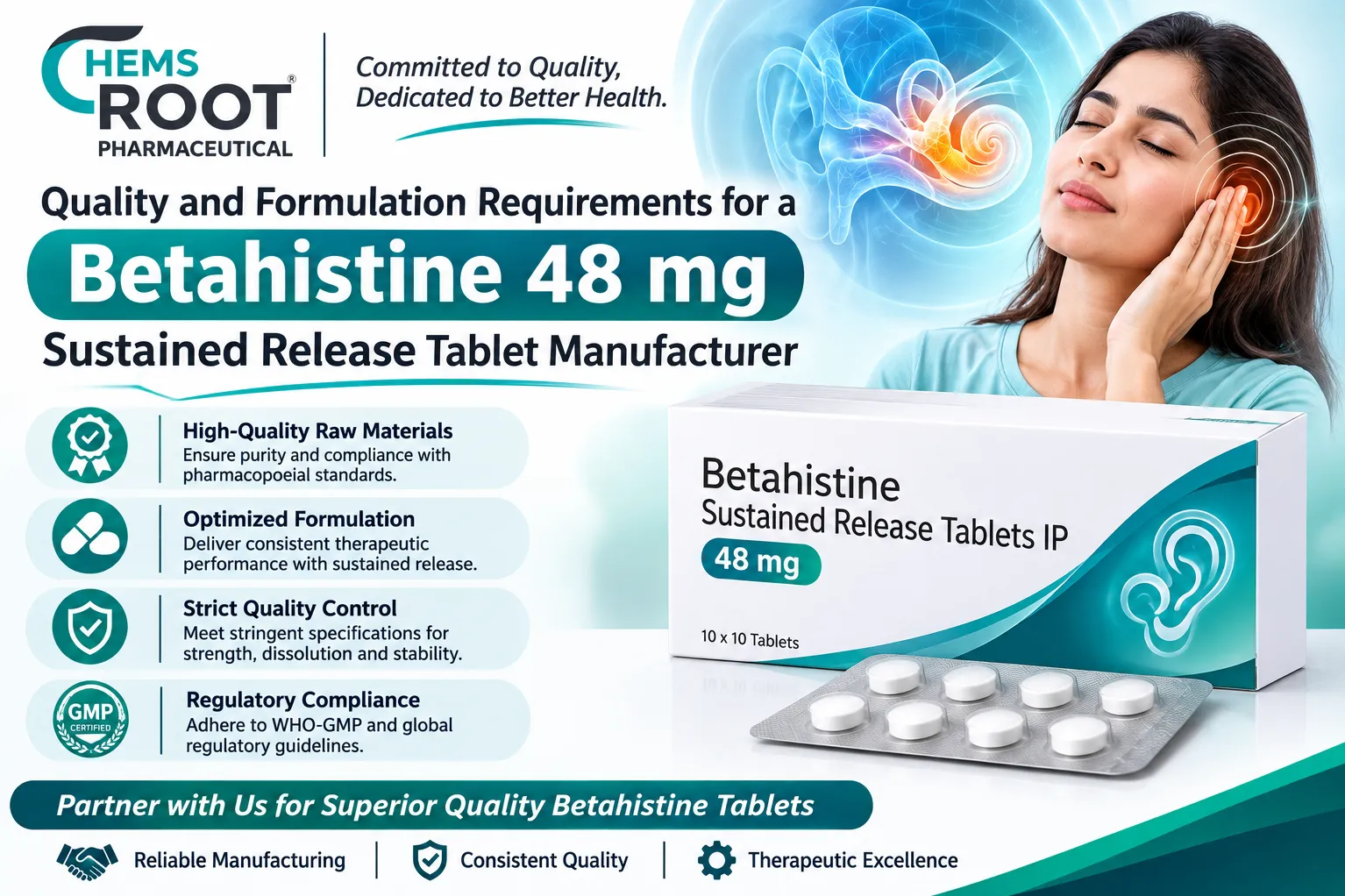
A 48 mg sustained-release betahistine tablet cannot be specified safely until the strength basis, salt form, release mechanism, and performance tests are defined. By the end, you will have a practical checklist for evaluating the API, formulation, dissolution data, finished-product controls, stability package, and manufacturing agreement.
Key takeaways
- Confirm whether 48 mg means betahistine base or dihydrochloride salt.
- Request API identity, assay, impurity, and supplier qualification records.
- Demand multi-point dissolution data that distinguishes the release profile.
- Review stability results, batch records, and a signed quality agreement.
Define the 48 mg Strength Before You Compare Manufacturers
“Betahistine 48 mg” is incomplete unless it states whether 48 mg means betahistine dihydrochloride or betahistine base equivalent. That distinction changes the tablet mass, label claim, and assay calculation. Using molecular weights of about 209.12 for the dihydrochloride salt and 136.19 for the base, the relationship is:
Label basisWhat 48 mg meansApproximate corresponding massBetahistine dihydrochloride48 mg of the salt48 mg salt, about 31.3 mg baseBetahistine base equivalent48 mg of active moietyAbout 73.7 mg dihydrochloride salt
State one basis consistently in the strength specification, product artwork, certificate of analysis, master formula, and regulatory dossier. The assay must identify whether potency is reported as salt or base equivalent; a bare “48 mg” or “100% assay” leaves the claim ambiguous.
- Ask for the approved formula showing the salt name, nominal amount per tablet, assay limits, molecular-weight conversion factor, and potency basis.
- Reconcile that wording across the certificate of analysis and finished-pack artwork before approval.
- Require evidence that the 48 mg sustained-release batch was developed at that strength. Proportional scaling from a lower-strength tablet does not prove blend uniformity, compression behaviour, mechanical integrity, or release performance.
Qualify the API and Prove the Release-Controlled Formulation
A consistent sustained-release dose starts with a defined salt, a controlled API, and a reproducible release mechanism. Confirm whether “48 mg” means betahistine base equivalent or the stated hydrochloride salt, then use that basis consistently in the specification, assay calculation, artwork, and certificate of analysis.
Qualify the betahistine hydrochloride API with:
- identity testing that distinguishes the specified salt from other forms
- a stability-indicating assay and related-substances method
- particle size distribution, because large shifts can change blend uniformity, compaction, and drug release
- impurity limits, water content, and supplier batch-to-batch trend data
Assay alone cannot prove chemical quality or dose uniformity. Request representative API results, not only a supplier declaration.
Lock the variables that control release during development and scale-up. Polymer viscosity grade and concentration affect gel strength; hydration behaviour affects matrix erosion; porosity and compression force affect water penetration; coating weight controls diffusion from coated tablets or multiparticulates.
DesignMain release controlVariables to lockHydrophilic matrixPolymer swelling and erosionPolymer grade, viscosity, concentration, porosityInsoluble matrixDiffusion through a water-insoluble structureDrug distribution, pore former, compression forceCoated tablet or multiparticulateMembrane-controlled diffusionCoating polymer, weight gain, curing conditions
Prove consistency with dosage-unit uniformity and a multi-point dissolution profile. Any change in site, equipment, batch size, compression, coating, or polymer grade requires documented comparability; a matching assay or appearance does not establish equivalent release.
Demand a Discriminating Multi-Point Dissolution Profile
Require a multi-point sustained-release dissolution profile, not a single end-point result. The profile must show early, middle, and late release through defined sampling intervals; otherwise, an initial burst or incomplete final release can remain hidden.
Ask for the complete method: dissolution medium, volume, pH, temperature of 37 ± 0.5°C, agitation speed, sampling schedule, filtration details, assay procedure, and acceptance criteria for each interval. USP Apparatus II may be suitable, but the manufacturer must justify the apparatus and demonstrate that the method distinguishes meaningful formulation changes.
Request representative finished-product batch data, not only a certificate of analysis:
- Complete dissolution curves and between-batch variability
- Assay, dosage-unit uniformity, impurities, and degradation products
- Hardness or mechanical-integrity results, plus friability where applicable
- Stability-time-point profiles showing that release remains controlled
The dissolution method should detect changes in polymer grade or concentration, granule properties, compression force, coating weight, and manufacturing scale. A method that gives the same passing result after those changes is confirmatory, not discriminating.
Bioequivalence evidence must compare the 48 mg sustained-release tablet with the registered reference product required by the target authority. Do not assume that two 24 mg immediate-release tablets are interchangeable. Review comparative pharmacokinetic data, the approved comparator, study conditions, and any post-approval-change assessment; assay alone cannot prove equivalent release or performance.
Set Finished-Product Specifications and Stability Controls
Do not release a batch on assay alone. The finished-product specification must show chemical identity, dose uniformity, tablet integrity, and controlled release, using validated, stability-indicating methods. State whether 48 mg means betahistine dihydrochloride or betahistine base equivalent, and use that basis consistently.
Control areaTests or evidence to requireFailure it preventsRelease specificationIdentification; assay; content uniformity; related substances, including named degradation products and process impurities; hardness and friability; appearance; water content where relevant; and a multi-point dissolution profile at early, middle, and late intervalsA correct average assay can conceal uneven dosing, contamination, weak tablets, or dose dumpingStability protocolAppearance; assay; content uniformity where justified; related substances and degradation products; hardness, friability, water content, and the complete dissolution profile at each scheduled intervalChemical growth of impurities or polymer changes can alter release before the expiry datePackaging justificationStability data in the proposed container closure; moisture and light sensitivity assessment; seal integrity; water-vapour protection; and compatibility or extractables assessment for bottle, blister, foil, desiccant, ink, and adhesiveA sound formulation can fail after moisture ingress, light exposure, or package interaction
Set dissolution conditions precisely: medium, apparatus, agitation speed, temperature at 37 ± 0.5°C, sampling times, and limits. The method must detect changes caused by polymer grade, polymer level, compression force, granule properties, coating weight, or scale. Use representative batch data, not only a certificate of analysis.
Use Batch Evidence and a Quality Agreement to Select the Manufacturer
Approve a manufacturer only after reviewing evidence from multiple finished-product batches and signing a quality agreement. A certificate of analysis confirms one batch’s reported results; it does not prove consistent release from a sustained-release tablet.
1. Request representative batch data for at least assay, dosage-unit uniformity, related substances, tablet hardness or mechanical integrity, friability where applicable, and the complete multi-point dissolution profile. Compare release limits and batch-to-batch variability, not only the average result.
2. Confirm that the specification, artwork, certificate of analysis, and regulatory dossier state whether 48 mg means betahistine dihydrochloride or betahistine base equivalent. Require the assay-conversion basis in writing; inconsistent strength definitions can make an apparently compliant batch legally and clinically ambiguous.
3. Use the quality agreement to assign API qualification, approved-supplier control, reference-standard custody, method transfer, deviation investigation, OOS/OOT decisions, stability ownership, supplier change notification, and regulatory notification. For distribution, assign storage, transport records, complaint handling, recall execution, and batch traceability.
4. Review the stability-indicating assay and related-substances method, plus validation and method-transfer records. Require documented comparability after a site, equipment, batch-size, process, or release-control change, including dissolution-profile comparison or new bioequivalence evidence when the authority requires it.
If Chemsroot Pharmaceutical is considered for this product, assess its proposed 48 mg dossier and batch evidence against these controls rather than inferring capability from other tablet listings. A signed manufacturing contract does not replace the quality agreement.
Frequently asked questions
- Why must you define the 48 mg betahistine strength before comparing manufacturers?
- Because 48 mg of betahistine dihydrochloride is not the same mass as 48 mg of betahistine base. The label claim and assay calculation must identify the salt or base-equivalent basis.
- What evidence should a manufacturer provide for the betahistine API?
- Request the API specification, certificate of analysis, identity and assay results, impurity profile, supplier qualification records, and documentation showing control of storage and handling.
- How do multi-point dissolution tests evaluate a sustained-release formulation?
- Samples taken at several defined time points show whether the tablet releases betahistine gradually and consistently rather than releasing most of the dose immediately.
- Which finished-product and stability records should you review?
- Review finished-product specifications, assay and impurity limits, dissolution results, content uniformity, packaging controls, and stability data from the proposed market pack.
- What batch evidence and agreement should you require before selecting a manufacturer?
- Ask for executed batch records, certificates of analysis, deviation and change-control procedures, relevant licence copies, and a quality agreement defining responsibilities, testing, release, complaints, and recalls.
Keywords