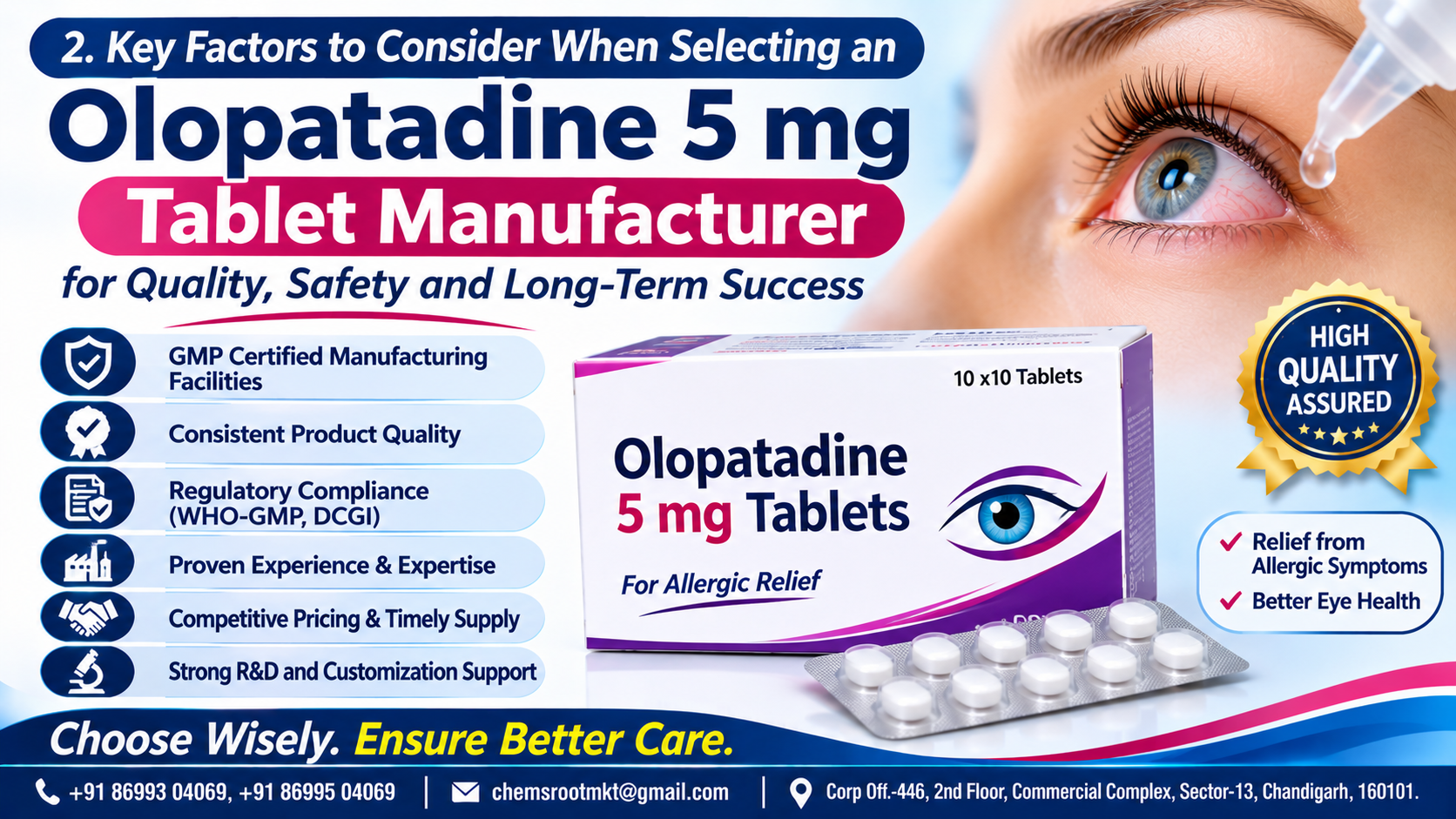
A supplier that lists olopatadine products may produce only ophthalmic drops, while a quoted “5 mg tablet” may refer to the hydrochloride salt rather than 5 mg of olopatadine base. By checking product identity, site authorization, quality evidence, stability, regulatory documents, and supply capability in the right order, you can reject unsuitable manufacturers before committing to samples or a purchase order.
Key takeaways
- Confirm the product is an immediate-release 5 mg oral tablet.
- Request batch specifications, test reports, and the manufacturing licence.
- Check API source, formulation stability, and target-market shelf-life requirements.
- Define approval, packaging, delivery, and responsibility terms before ordering.
Does the manufacturer produce the exact oral tablet you need?
An olopatadine 5 mg tablet manufacturer must prove that it makes the exact oral product, not merely olopatadine 0.1% or 0.2% eye drops or a nasal product. Confirm production at an authorized oral solid-dose site and identify the dosage form as an immediate-release tablet, not a modified-release product or unapproved alternative.
Ask the supplier to provide:
- The tablet’s composition and labelled strength: “olopatadine hydrochloride equivalent to 5 mg” or 5 mg of the hydrochloride salt.
- The manufacturing site name, manufacturing licence, approved product permission, and dosage-form scope covering oral tablets.
- The registered product name, target-market registration or acceptance, and the applicable IP, BP, USP, or approved in-house specification.
- A product-specific quality dossier, including the finished-product specification, dissolution profile, stability package, and comparative bioequivalence evidence when the destination regulator requires it.
The strength basis must match across the purchase specification, label, assay calculation, and certificate of analysis. Five milligrams of olopatadine hydrochloride is approximately 4.51 mg of olopatadine base; a claim of 5 mg olopatadine base requires more hydrochloride salt. Do not approve ambiguous wording.
An oral tablet is the wrong choice when the intended indication requires an ophthalmic formulation, another strength, modified release, or a locally approved product with different requirements. Confirm the dosage form before comparing price or lead time.
What quality evidence proves that every batch meets its specification?
A qualified manufacturer can show batch-specific evidence, not merely a catalogue claim. Request the approved IP, BP, USP tablet specification, or an approved in-house standard, then confirm that it defines identity, assay and content uniformity, dissolution, disintegration, friability, hardness, appearance, related substances, and microbial limits when required.
EvidenceWhat to verifyWarning signRelease specificationNamed standard, test methods, limits, and calculation basisUndated or generic specificationDissolution testingApparatus, medium, agitation speed, sampling points, acceptance limits, and discriminatory method used during development“Passes dissolution” with no methodCertificate of analysisBatch number, manufacturing date, expiry date, assay, dissolution, required microbial results, and authorized quality-control approvalSample or product-level certificate
Ask for trend data from process design, process qualification, and continued process verification. Review assay and content uniformity, dissolution, hardness, friability, yield, and critical in-process parameters across commercial batches; three successful batches alone do not prove continuing control.
- Match the GMP certificate to the exact facility manufacturing the tablets.
- Confirm the certificate of analysis belongs to the batch offered.
- Check that out-of-trend results, deviations, retesting, and rejected batches are documented and investigated.
A company-level GMP statement does not qualify an unrelated site. Missing batch records, unexplained trends, or a certificate signed without authorized quality-control approval should stop release until the manufacturer supplies verifiable evidence.
Are the API, formulation, and shelf life suitable for the target market?
A 5 mg tablet is suitable only when you can trace its olopatadine API from the actual API manufacturer and API lot to the finished-tablet batch. Complete olopatadine API qualification by requesting the API certificate of analysis, impurity profile, residual-solvent controls, retest period, synthesis route and route-change history, GMP evidence, and written change-notification commitment.
Ask the manufacturer for:
- A risk assessment covering degradation products, mutagenic impurities under ICH M7, elemental impurities under ICH Q3D, and nitrosamine risk.
- The complete excipient list, coating system, colourants, allergen declaration, lactose or other intolerant-excipient information, and suitability for the intended patient population and regulatory market.
- Evidence that the commercial formulation remains within specification in the exact marketed blister or bottle, seal, and desiccant configuration.
The stability package must support the proposed expiry, storage temperature, and humidity protection after distribution. Review ICH Q1A stability data for long-term storage at 25°C/60% relative humidity or 30°C/65% relative humidity, accelerated testing at 40°C/75% relative humidity, and the applicable 30°C/75% relative-humidity condition for hot, very humid markets.
Confirm the labelled condition for climate zone IVa IVb. Alu-alu or HDPE alone proves nothing; the exact pack and seal need supporting data.
Can the manufacturer support approval, packaging, and shared responsibilities?
A manufacturer is commercially ready only when it can document approval, protect the marketed pack, and accept written responsibility for regulatory and safety work.
1. Request the product dossier, finished-product specification, batch certificate of analysis, stability summary, licence copies, GMP certificate, packaging-material specification, and transport or storage instructions. If the market requires a bioequivalence study, obtain its design, reference product, analyte definition, pharmacokinetic methods, statistical analysis, and 90% confidence intervals for relevant log-transformed exposure parameters.
An in-vitro dissolution comparison alone may not satisfy the requirement.
2. For export, check three separate documents: the manufacturing-site GMP certificate, the product-specific Certificate of Pharmaceutical Product, and marketing authorization in the destination country. Confirm who owns the local authorization and whether legalized documents, approved artwork, and climate-zone stability data are required.
3. Compare alu-alu blister packaging with PVC/PVDC options, then confirm pack count, child-resistant or tamper-evident features, batch coding, and readable manufacturing and expiry dates. Verify line clearance, printed-material reconciliation, barcode or vision checks, strength-specific segregation, and mix-up investigations where the site makes multiple tablet strengths.
4. Sign a quality agreement assigning artwork approval, change control, deviations, complaints, recalls, pharmacovigilance, regulatory responses, dossier ownership, variation approval, batch release, supply-interruption notice, and audit rights. Without these clauses, commercial exclusivity does not guarantee regulatory continuity or safety accountability.
How should you compare supply reliability before signing the purchase order?
Reject a low tablet price if the supplier cannot show consistent, traceable batches and a realistic delivery plan. Compare total cost, including delays, small-batch fees, testing, and administrative work.
Comparison pointAsk forRisk if unclearCapacityMinimum order quantity, lead time, production capacity, and forecast requirementsStockouts or excess inventoryApprovalSample-approval process and trial-order termsPaying for an unapproved batchCommercial termsCredit terms and charges for tooling, artwork, testing, and small batchesLowest quote becomes expensivePerformanceDelivery records and interruption-notice periodNo warning before supply failure
Ask for explanations of rejected batches, retesting, deviations, and delivery delays. This pharmaceutical supplier screening checklist should also cover the quality agreement, batch-release responsibility, variation approval, complaints, recalls, audit rights, and dossier ownership.
For PCD pharma supply reliability, verify temperature and humidity mapping, excursion handling, carrier qualification, and returned-goods decisions. Require recall traceability across the manufacturer, distributor, importer, and PCD partner.
Before ordering:
- Inspect a representative sample and approve the specification and artwork.
- Define batch-release criteria and a change-notification timeline.
- Set a complaint response time and run a mock recall using the batch number.
If assessing Chemsroot Pharmaceutical, request these commitments and records rather than qualifying a catalogue listing. Score document access, regulatory continuity, batch consistency, delivery performance, and total administrative effort beside the quoted price.
Frequently asked questions
- How can you confirm a manufacturer makes the exact olopatadine product you need?
- Verify that the manufacturer produces an authorized immediate-release olopatadine 5 mg oral tablet at an oral solid-dose facility. Do not treat olopatadine eye drops or nasal products as equivalent.
- What quality evidence should an olopatadine tablet manufacturer provide?
- Request the product specification, certificate of analysis, batch number, manufacturing and expiry dates, stability data, and evidence of testing for identity, assay, dissolution, impurities, content uniformity, and microbial limits where applicable.
- What API and shelf-life checks matter before selecting a manufacturer?
- Confirm the API source, pharmacopoeial or approved specification, formulation compatibility, stability results, storage conditions, and remaining shelf life required when the product reaches your target market.
- What regulatory and packaging responsibilities should the contract define?
- Assign responsibility for registration documents, artwork, language, pack size, serialization, tamper evidence, pharmacovigilance, change control, complaints, recalls, and release testing in writing.
- How should you compare supply reliability between manufacturers?
- Compare validated production capacity, lead times, minimum order quantities, batch-release timelines, inventory plans, business continuity arrangements, delivery records, and the process for handling shortages or delayed shipments.
Keywords