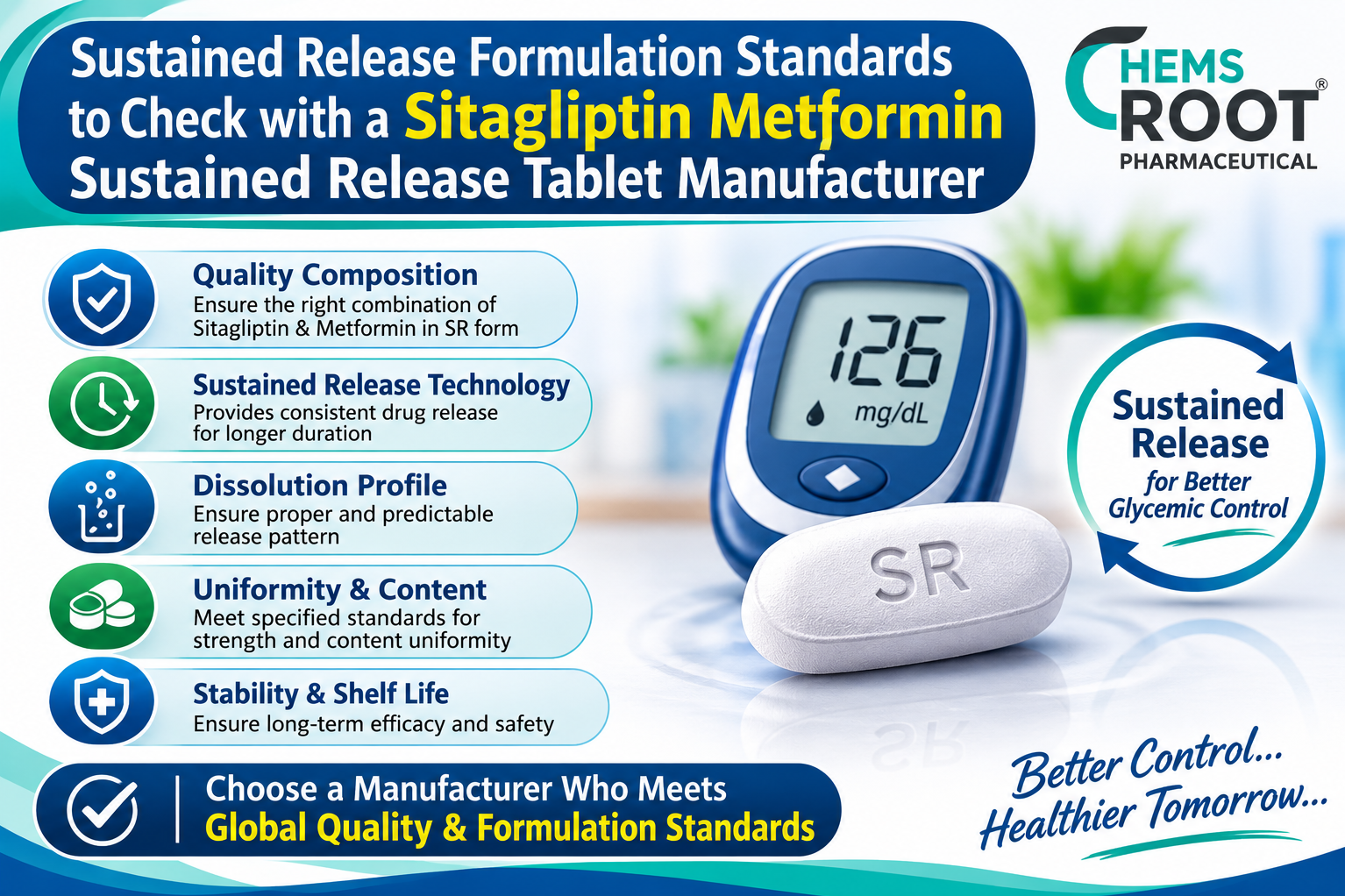
A sitagliptin/metformin tablet is not adequately qualified by strength, assay, and a single dissolution result. You need to confirm which ingredient is extended-release, how each active is controlled, which standards govern the product, and whether the manufacturer can support validation, stability, and regulatory documentation.
Key takeaways
- Confirm the exact sitagliptin and metformin strengths before comparing suppliers.
- Request separate dissolution and bioequivalence evidence for both active ingredients.
- Check finished-product specifications against named pharmacopoeial and ICH controls.
- Review stability data, packaging qualification, validation, and change-control records.
Confirm the Product Architecture, Strengths, and Release Claim
Before comparing suppliers, require the manufacturer to prove exactly which sitagliptin metformin sustained release tablet it makes, in which strengths, and what “sustained release” describes. Confirm whether the portfolio includes sitagliptin 50 mg metformin 500 mg and sitagliptin 50 mg metformin 1000 mg, rather than assuming another antidiabetic tablet is equivalent.
DesignRelease claimEvidence to requestBilayer tabletOne layer may release sitagliptin immediately while the metformin layer releases over timeLayer composition, manufacturing diagram, layer-weight controls, and separate dissolution profilesMatrix tabletMetformin release depends on polymer hydration, swelling, or erosionPolymer grade and viscosity, matrix design, and release-mechanism studyOsmotic or other systemMembrane, pore, or device controls drug deliverySystem schematic, critical dimensions, and justification for the selected design
The dossier must state the release target for each active: dissolution medium, apparatus, agitation speed, temperature, sampling time points, acceptance ranges, and validated analytical method. A combined result is inadequate because one active can meet assay while the other releases incorrectly.
Ask for bioequivalence evidence covering both actives and the extended-release claim, including fasting and fed conditions and alcohol-dose-dumping assessment where relevant.
Require tablet-strength and handling data as well. Check hardness, friability, coating and packaging robustness, and evidence that any score line is not intended for dose splitting; the reference extended-release tablet is not to be split, crushed, or chewed.
Obtain change-control commitments covering polymer or metformin-grade changes, compression force, dimensions, coating, lubricant level, and manufacturing site, with comparative dissolution and regulatory-trigger criteria.
Demand Separate Dissolution and Bioequivalence Evidence for Both Actives
A single combined dissolution result cannot show whether each active follows its intended release profile. Request separate, time-point data for sitagliptin and metformin, quantified with a method that distinguishes both compounds and their degradation products. The dossier must explain whether sitagliptin releases immediately while metformin remains extended-release, or whether both use controlled-release mechanisms.
Ask for these records:
- A dissolution profile for each active across the intended pH range, identifying the dissolution medium, USP apparatus, agitation speed, temperature, sampling times, and acceptance range at every time point.
- Evidence that the method is discriminatory: deliberate changes in polymer level, granule size, compression force, or coating thickness must produce detectable profile changes.
- Method validation covering specificity, precision, accuracy, recovery from the combined tablet matrix, filter adsorption, solution stability, and robustness to pH and agitation changes.
The method must transfer between laboratories without changing the conclusion. Compare individual release curves, not only a total percentage released or one final measurement.
Bioequivalence evidence must also evaluate both actives and the extended-release behaviour. Request the fasting and fed study design, pharmacokinetic results for sitagliptin and metformin, and justification that the product meets the applicable regulatory criteria.
Ask whether alcohol dose-dumping was assessed where relevant; rapid metformin release after alcohol exposure can reveal a dangerous failure hidden by routine dissolution.
Match the Finished-Product Specification to Pharmacopoeial and ICH Controls
The specification must set separate acceptance criteria for sitagliptin and metformin; one combined assay can hide an under-strength component. Align the limits and test methods with the applicable Indian Pharmacopoeia monograph, USP monograph, and ICH Q6A principles rather than accepting a generic “passes specification” statement.
Standard or controlEvidence to requireFailure it preventsIndian Pharmacopoeia and USP monographApplicable identity, assay, dosage-unit uniformity, dissolution, and impurity methods with acceptance limitsAn unverified in-house method or unsuitable compendial methodICH Q6AJustification for specification limits, analytical procedures, and release versus shelf-life criteriaArbitrary limits that do not reflect product qualityICH M7 nitrosamine risk assessmentNDMA assessment covering API, excipients, water, processing, packaging, and storage degradation; validated testing or justified skip-testingUndetected mutagenic contamination in a metformin product
The finished-product dossier should also identify known and unknown related substances separately from degradation products, with reporting and qualification thresholds. Require a toxicological assessment for every potentially mutagenic impurity under ICH M7, not merely a total related-substances limit.
Check individual assay, dosage-unit uniformity for both actives, identification, each active’s dissolution profile, water content where relevant, and microbial limits when justified by the formulation and pack. Ask for in-process controls linking blend uniformity, tablet weight, compression force, coating weight gain, and dissolution to the finished-product results.
Inspect Process Validation, Tablet Strength, and Change-Control Records
A credible dossier connects process validation to three commercial batches, not just a finished-product certificate. Request the validation protocol and report, continued process verification trends, sampling plans, and results for assay, content uniformity, tablet weight, hardness, friability, and dissolution for each strength.
Ask for records that identify the approved operating ranges and investigate excursions:
- Blending records should show API particle-size distribution, metformin granule density, lubricant quantity, blend time, sampling locations, and blending uniformity results.
- Compression records should show tablet weight, thickness, hardness, compression force, rejection rates, and any link between force changes and dissolution or content uniformity.
- Coating records should show polymer lot, viscosity or substitution grade, spray rate, inlet and product temperatures, pan speed, drying conditions, and coating weight gain.
- Packing records should document line clearance, seal integrity, pack-material approval, environmental controls, reconciliation, and tablet damage or friability after packing.
StageRecord to inspectWhat it provesBlendingBlend assay and uniformity mapEach compression run receives the intended doseCompressionIn-process weight, force, hardness, and dissolution or surrogate dataMechanical settings do not shift releaseCoatingWeight-gain trend and coating-endpoint resultsFilm thickness remains within the validated release windowChange controlRisk assessment, comparative dissolution, notification decision, and revalidation planFuture changes remain controlled
Require change control for metformin grade, polymer supplier, lubricant level, dimensions, compression force, coating process, or site. The procedure must state when comparative dissolution, regulatory notification, or a new bioequivalence assessment is required.
Use Stability, Packaging, and Quality-Agreement Evidence to Select the Manufacturer
Require evidence from the licensed manufacturing site, not a marketing company’s certificate, before appointing a contract manufacturer or distribution partner. Confirm who releases each batch, where records are stored, and whether the proposed site is authorised to manufacture this product for the destination market.
1. Request stability data for the finished tablets in the marketed pack. ICH stability testing should include six months at 40°C/75% RH, plus long-term data at 25°C/60% RH or 30°C/75% RH matched to the export climate. Review assay, each active’s dissolution, impurities, water uptake, appearance, hardness, friability, and tablet integrity at every interval.
2. Match the data to the proposed packaging. Require moisture-permeation qualification and stability in the actual alu-alu blister, PVC/PVdC blister, or HDPE bottle; these formats are not interchangeable for a moisture-sensitive release system.
Ask for coating and packaging robustness data, and confirm that any score line does not imply permission to split a tablet labelled not to be split, crushed, or chewed.
3. Sign a quality agreement covering deviation investigations, OOS and OOT results, data-retention periods, reference and stability-sample ownership, recall authority, complaint deadlines, subcontractor approval, and access to raw electronic records. Add storage-temperature excursions and transport monitoring for a distribution partner.
Chemsroot Pharmaceutical should face this same evidence test when its sustained-release expertise is assessed against a sitagliptin/metformin brief: documented site capability matters more than a broad product catalogue. Reject a partner that withholds protocol-level stability data or assigns batch-release responsibility vaguely.
Frequently asked questions
- Which product details should you confirm with a sitagliptin metformin sustained-release tablet manufacturer?
- Confirm the tablet architecture, the release mechanism, and the exact strengths offered, including whether the manufacturer supplies sitagliptin 50 mg with metformin 500 mg and 1000 mg.
- Why are separate dissolution and bioequivalence records needed for both actives?
- Sitagliptin and metformin have different release and absorption requirements. Ask for evidence that evaluates each active rather than relying on a single overall product claim.
- What finished-product specifications should you compare?
- Compare assay, content uniformity, dissolution, related substances, identification, microbial limits where applicable, and other specifications against the named pharmacopoeial monographs and ICH controls.
- Which manufacturing records help verify tablet quality?
- Inspect process-validation protocols and reports, compression and coating controls, tablet-strength data, deviation investigations, and change-control records.
- What stability and packaging evidence should a manufacturer provide?
- Request long-term and accelerated stability data for the proposed pack, along with packaging qualification, moisture and light protection evidence, batch records, and a signed quality agreement.
Keywords