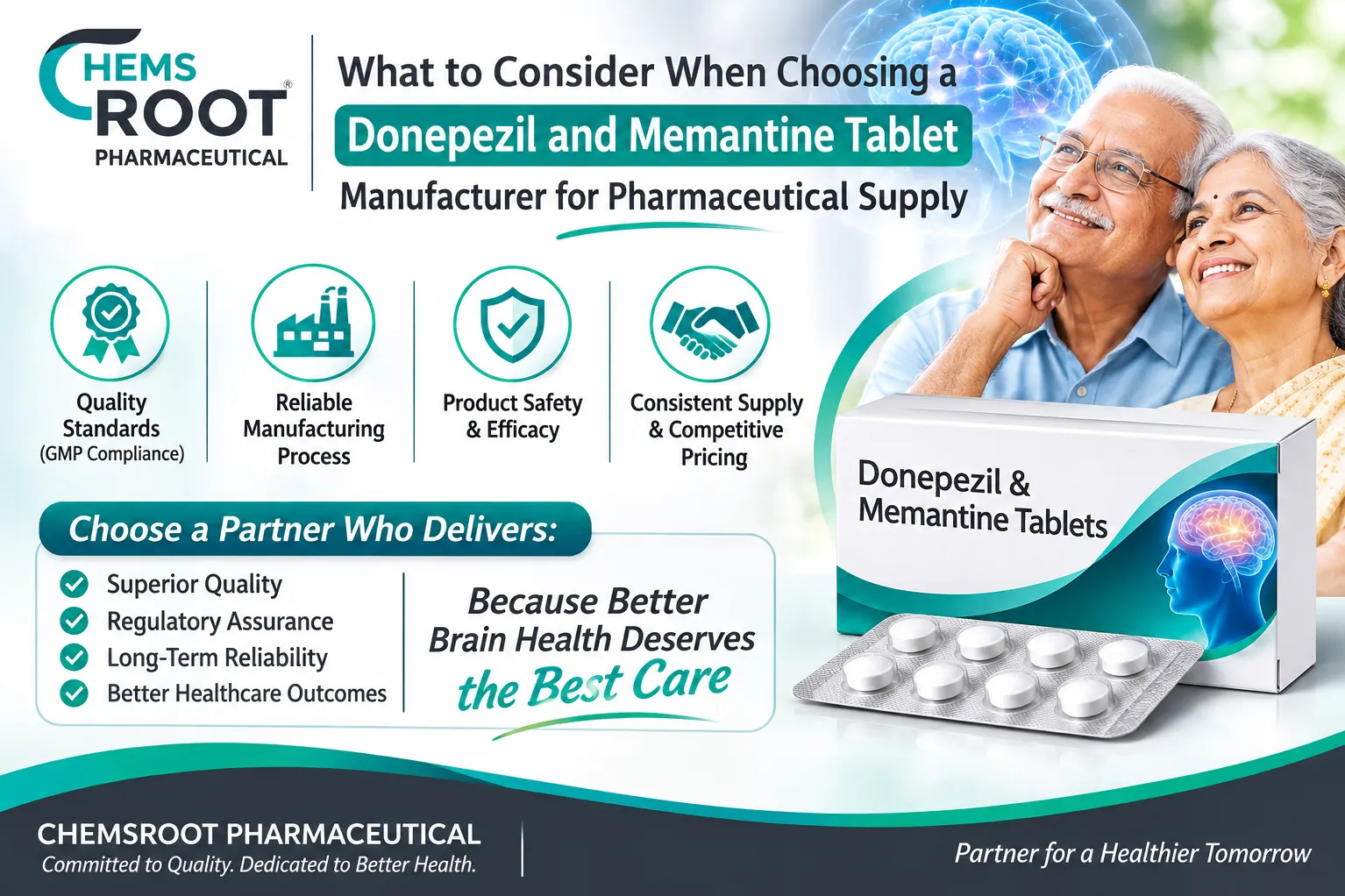
A supplier’s claim that it offers a donepezil–memantine tablet does not establish the product’s dose, release profile, clinical fit, regulatory status, or commercial reliability. By checking the formulation, evidence package, manufacturing controls, and supply responsibilities in sequence, you can distinguish a qualified source from a catalogue listing that is not ready for pharmaceutical supply.
Key takeaways
- Request the exact strengths, dosage form, indication, and titration schedule.
- Compare dissolution, release characteristics, and bioequivalence evidence for the proposed presentation.
- Inspect GMP records, assay results, stability data, and packaging specifications.
- Put batch documents, change controls, forecasts, and acceptance criteria into the supply agreement.
Confirm the exact product and the patients it is designed to serve
Verify that the manufacturer actually produces the proposed presentation, not merely a product containing both ingredients. Request the exact donepezil memantine strengths, tablet or capsule form, Alzheimer’s disease stage, approved indication, and titration schedule.
Namzaric is a capsule combining immediate-release donepezil with extended-release memantine. Its listed strengths contain 10 mg donepezil with 7, 14, 21, or 28 mg memantine extended release; memantine is titrated in 7 mg weekly increments before reaching 28 mg. A different ratio, immediate-release memantine, or conventional fixed-dose tablet is not automatically interchangeable. Ask for:
- The manufacturer’s product-specific regulatory and bioequivalence justification.
- The intended patient population, including whether patients must already be stable on donepezil 10 mg.
- A prescribing pathway for patients needing a lower dose, renal memantine adjustment, or withdrawal of one ingredient.
- A duplication check preventing combination dispensing alongside separate donepezil or memantine.
OptionWhat it meansWhen it appliesSeparate tabletsStart, stop, or adjust each ingredient independentlyUnstable treatment, lower doses, renal adjustment, or withdrawal of one medicineFixed-dose combinationOne product can reduce pill burden after titrationPatients stable on both ingredients at the matched dosesNamzaric comparison10 mg donepezil with 7, 14, 21, or 28 mg extended-release memantineOnly when release characteristics, strength, indication, and evidence align
Do not accept “contains donepezil and memantine” without each ingredient’s milligram amount. A simpler pack cannot compensate for an unsuitable dose architecture.
Match release characteristics, tablet design, and bioequivalence evidence
A similar-looking tablet can produce a different exposure profile when its release-limiting matrix, coating, dose ratio, or compression differs from the reference product. Require the manufacturer to state whether the formulation contains immediate-release donepezil and extended-release memantine, or a different modified-release tablet design.
FeatureCombination tabletSeparate tabletsRelease designMust reproduce or justify each active’s release profileEach product has its own established profileAdministrationOne pack can reduce pill burden after titrationMore tablets, but independent dosingDose flexibilityLimited when one ingredient needs adjustmentAllows either ingredient to start, stop, or change alonePhysical designConfirm film-coated, swallowable, scored, and approved for splittingCheck these features for each tablet
Ask which excipients control memantine release and whether the coating or matrix changes with strength. Document tablet splitting and scoring instructions; a score line does not prove that splitting is approved, and unsafe splitting can disrupt modified release or deliver an inaccurate dose.
Request the jurisdiction-specific bioequivalence strategy: comparative pharmacokinetic studies, comparative dissolution, or a justified biowaiver where permitted. For immediate-release and modified-release components, review separate dissolution profiles for both actives, every sampling time point, acceptance criteria, and discriminatory capability after formulation or compression changes. One final pass/fail point is inadequate.
Compare the combination with separate tablets for adherence, administration burden, and the clinical need to adjust either ingredient independently. An IP assay or familiar brand name does not prove interchangeability.
Examine two-active-ingredient manufacturing and laboratory controls
A tablet can meet its target weight while delivering too little donepezil. Because donepezil may be the lower-dose component, weight uniformity does not prove dose uniformity; segregation during processing can leave the first and last tablets with different active-ingredient levels.
1. Request the finished-product specification and representative batch data for identification of both actives, finished-product assay, content uniformity, dissolution, degradation products testing, water or moisture where relevant, and microbial quality where applicable. Require separate dissolution results for donepezil and memantine when their release characteristics differ.
2. Review the blend uniformity plan: sampling locations, sample size, timing, acceptance limits, and laboratory validation. The method must distinguish each active from excipients and degradation products, and demonstrate specificity as a stability-indicating method.
3. Ask how the site prevents segregation during dispensing, blending, transfer, hopper holding, compression, coating, and packaging. For a contract manufacturer, inspect commercial-scale process validation and continued process verification for blending, compression, coating or modified-release manufacture, cleaning, and packaging.
4. Require original laboratory data, chromatograms, dissolution records, electronic audit trails, and investigation reports, not only signed certificates of analysis. A historical batch certificate or successful exhibit batch supports qualification but cannot prove continued control after scale-up, equipment changes, or a new API or excipient source.
The technical agreement should define these tests, methods, limits, records, and change-notification duties before the first purchase order. Verify that any proposed change is assessed for its effect on segregation, assay, uniformity, dissolution, and degradation products.
Verify registration, stability, packaging, and the technical supply file
A current GMP certificate does not prove that a specific donepezil–memantine tablet has legal permission for import or sale. Verify the product registration or marketing authorisation, manufacturing authorisation, dossier ownership, approved formulation, approved artwork, package insert, pharmacopoeial specifications, and permitted label claims for the destination country.
Request these additional records before approval:
- A certificate of pharmaceutical product, or the destination market’s equivalent
- Batch-specific certificates of analysis identifying both active ingredients
- A reference sample matching the proposed commercial pack
- Stability data covering the labelled shelf life and in-use period
Match the evidence to the proposed pack and climate.
Condition or evidenceWhat to verifyWhy it mattersLong-term 25°C/60% RH or 30°C/65% RHResults for the destination climateConfirms labelled shelf life under applicable ICH conditionsAccelerated stability data 40°C/75% RHAssay, degradation products, dissolution, moisture, and appearanceExposes heat-and-humidity failure before shipmentAlu-alu, HDPE, or other packMoisture and light protection, shipping exposure, opening behaviour, and relevant extractables or leachables assessmentA pack name alone does not prove protection
Ask what happens after opening, during shipping, and at expiry. Before the first purchase order, put change control in the technical agreement for API source, excipient grade, tooling, compression, coating, release-control technology, analytical methods, manufacturing site, and packaging. State which changes need regulatory notification or approval before implementation.
Convert supplier qualification into a controlled commercial arrangement
Protect the approved source with a technical agreement and quality agreement before issuing a purchase order. This pharmaceutical supplier qualification must name the manufacturer, exporter, importer, local registration holder, and distributor, then assign accountability for each hand-off.
1. Define batch release, reference-sample storage, complaints, adverse-event intake, pharmacovigilance and recall responsibilities, product-quality investigations, batch traceability, regulator communication, returned goods, and destruction. State who makes the recall decision and who informs the regulator; never leave these duties inside a commercial invoice or PCD pharma franchise agreement.
2. For a PCD pharma franchise or distribution arrangement, identify the owner and controlled approver of the product dossier, approved artwork, package insert, and promotional claims. State who pays for confirmatory testing, investigation, replacement stock, transport, and recall action. Set record-retention periods, deviation-notification timelines, audit rights, and minimum notice before any manufacturing or packaging change.
3. Use a risk-based audit covering weighing, segregation controls, cleaning validation, blend sampling for the lower-dose donepezil, compression, modified-release coating, packaging, laboratory data integrity, audit trails, warehouse temperature and humidity records, and shipment controls. Require process-validation and continued-process-verification evidence at commercial scale.
4. A contract manufacturing quality agreement must require written change control for API source, excipient grade, tooling, compression, coating, analytical methods, site, and packaging.
Chemsroot Pharmaceutical belongs in the same product-specific review: request evidence for the proposed donepezil–memantine presentation, not unrelated tablet listings, and approve only when its regulatory pathway, quality data, and responsibilities fit the target market.
Frequently asked questions
- What product details should you confirm with a donepezil and memantine manufacturer?
- Confirm each active ingredient’s strength, the tablet or capsule form, immediate- or modified-release design, Alzheimer’s disease stage, approved indication, and titration schedule. Ask the manufacturer to identify the exact presentation it produces.
- Which evidence supports the tablet’s release characteristics and bioequivalence?
- Request the finished-product specification, dissolution profile, assay and content-uniformity results, reference-product comparison, and bioequivalence report for the same strengths and dosage form you plan to supply.
- How do you assess manufacturing and laboratory controls for two active ingredients?
- Review the manufacturing licence, GMP inspection history, validated assay methods for both actives, blend-uniformity controls, cross-contamination controls, stability chambers, out-of-specification procedures, and certificate-of-analysis format.
- What registration, stability, packaging, and supply documents should you request?
- Request registration or marketing-authorisation evidence, real-time and accelerated stability data, approved artwork, packaging specifications, storage conditions, shelf-life justification, batch-release documents, change-control procedures, and the technical supply file.
Keywords