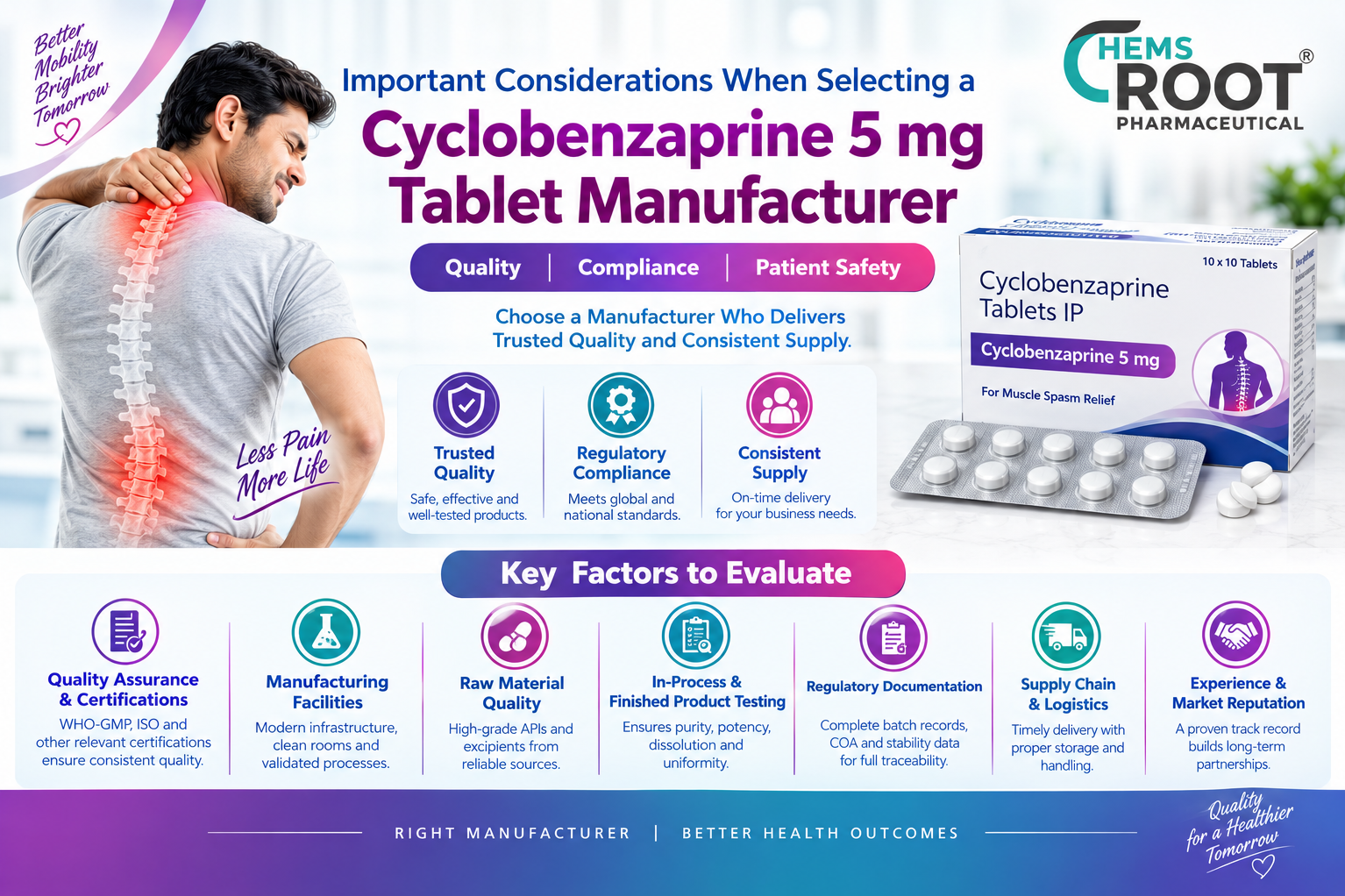
A supplier can offer a tablet labelled “cyclobenzaprine 5 mg” while leaving the active-ingredient form, release type, regulatory status, and batch evidence unclear. By the end, you will have a practical checklist for verifying the product, manufacturing site, quality data, stability package, packaging, and commercial responsibilities before placing an order.
Key takeaways
- Confirm immediate-release 5 mg tablets, not extended-release capsules.
- Request site licences, GMP evidence, and generic approval records.
- Review assay, dissolution, impurities, and uniformity results for each batch.
- Define packaging, stability, shipping, testing, and quality duties in writing.
Confirm the Exact Cyclobenzaprine 5 mg Product Before Comparing Suppliers
The cyclobenzaprine 5 mg tablet manufacturer must confirm that it makes an immediate-release cyclobenzaprine hydrochloride tablet, not a 15 mg or 30 mg extended-release capsule offered as an equivalent. Obtain the approved product name, dosage form, strength, active-ingredient statement, and market-specific label before comparing price or order quantity.
1. Confirm that the tablet contains cyclobenzaprine hydrochloride 5 mg, equivalent to 5 mg of cyclobenzaprine, rather than cyclobenzaprine free base. Ask which pharmacopoeial standard applies, such as IP or USP, and request the USP cyclobenzaprine tablet specification covering identity, assay, related substances, water or loss on drying, residual solvents, and dosage-unit uniformity.
2. Verify the release type in the product licence and finished-product specification. An immediate-release cyclobenzaprine tablet is not interchangeable with an extended-release capsule. Do not promote tablet splitting unless the approved information supports the score, equal halves, dose uniformity, and post-splitting stability.
3. Request the comparative dissolution method: apparatus, medium, agitation speed, sampling times, acceptance criteria, and profiles against the reference product. One passing time point can hide slow or variable release.
4. For a regulated generic market, require evidence of the accepted bioequivalence pathway for the exact 5 mg strength. Approval of another strength or an in-vitro comparison alone does not establish interchangeability unless the regulator accepted a strength waiver or another justified route.
A certificate of analysis reporting only assay is inadequate; it does not prove complete finished-tablet control.
Verify the Site, Licence, GMP Status, and Generic Approval Pathway
Ask for evidence tied to the actual manufacturing address, not a group company, trading office, or unrelated facility. The documents must cover the immediate-release cyclobenzaprine hydrochloride 5 mg tablet and the authority governing your destination market.
- Manufacturing authorisation showing the site address, approved dosage forms, tablet operations, validity period, and issuing regulator.
- Pharmaceutical manufacturer GMP compliance demonstrated by a current GMP certificate, inspection outcome, and scope covering solid oral dosage forms. Check the certificate’s site address and expiry date.
- Product licence verification for the exact strength, active form, manufacturer, pack, and immediate-release presentation. A licence for another strength, facility, or extended-release capsule is not enough.
- API traceability linking the cyclobenzaprine hydrochloride supplier and actual lot to its GMP status, route-specific impurity profile, residual-solvent controls, retest period, change-notification terms, and DMF or equivalent active-substance file where required.
For a regulated generic market, request the accepted cyclobenzaprine bioequivalence pathway for the exact 5 mg strength. Approval of a different strength or an in-vitro dissolution comparison does not establish interchangeability unless the regulator accepted a strength-waiver or another justified pathway.
Confirm that the proposed label and regulatory file name cyclobenzaprine hydrochloride equivalent to 5 mg cyclobenzaprine and cite the applicable pharmacopoeial standard, such as USP or IP. If the supplier cannot connect these approvals to the named site, treat its authorisation as unproven.
Demand Batch Data That Demonstrates Finished-Tablet Quality
Do not accept a cyclobenzaprine certificate of analysis that reports only assay. For every finished-tablet batch, match the certificate to the batch number, approved specification, test methods, acceptance limits, and laboratory results.
Request these records:
- The finished-product specification must identify cyclobenzaprine hydrochloride, distinguish it from cyclobenzaprine free base, and state the applicable IP or USP standard.
- The batch certificate must report identity, assay, water or loss on drying, dissolution, uniformity of dosage units, related substances and residual solvents.
- The executed batch record must link the tablet batch to the approved API supplier and actual API lot. Ask for the API supplier’s GMP evidence, impurity profile, residual-solvent controls, retest period, and change-notification commitment.
- The laboratory report must show individual results, not only “passes,” with the test method version and analyst or reviewer approval.
Quality questionEvidence to requestWhat a weak file revealsIdentityValidated identification test for cyclobenzaprine hydrochlorideAPI name appears without salt-form confirmationStrength and releaseAssay and dissolution testing against stated limitsAssay is reported without dissolution resultsDose consistencyUniformity of dosage units, with individual-unit resultsA blend result replaces tablet-by-tablet dataImpuritiesRelated substances and residual solvents results with limitsOnly a current API certificate is supplied
Reject unexplained omissions, copied results, or a certificate that cannot be traced to the supplied batch.
Match the Pack, Stability Evidence, and Shipment Conditions to Your Market
A proposed shelf life is credible only when the stability study uses the exact marketed container-closure system. Request cyclobenzaprine tablet stability data covering assay, related substances, dissolution, appearance, and water content at scheduled intervals. Bulk-tablet results do not justify a shelf life for a different bottle or blister.
Match the protocol to the destination climate. Ask whether 30°C/75% RH stability supports the intended hot, humid market; do not automatically transfer a temperate-market shelf life. Compare the protocol with ICH stability conditions, including 25°C/60% RH long-term, 40°C/75% RH accelerated, and 30°C/65% RH intermediate testing when applicable.
Qualify the complete pack, because moisture ingress can change dissolution and assay during distribution. Check:
- The marketed blister material, seal integrity, and blister packaging moisture protection
- The bottle, cap or induction seal, and desiccant quantity
- The label’s storage statement, pack size, and protection from light
- Stability results after the final packaging configuration is assembled
Shipment qualification must reflect actual exposure, not only warehouse storage. Review temperature and humidity logger data from transport lanes, define excursion limits, and confirm how the supplier handles rejected or damaged cartons.
If the product will cross hot ports or remain in non-air-conditioned storage, require evidence that the pack and shelf life remain within specification after those excursions. A shorter, evidence-based shelf life is safer than an unsupported expiry date.
Put Quality Responsibilities and Commercial Terms in the Manufacturing Agreement
Do not sign on price and territory alone. A third-party pharmaceutical manufacturing agreement must name the product owner, authorised site, batch-release party, and deviation and OOS responsibility. It must also state who investigates complaints, approves changes, retains samples, prepares the annual product quality review, and funds a recall.
Set these terms in writing:
- Dossier ownership, product registration maintenance, pharmacovigilance and adverse-event reporting, label and artwork control, serialization, local-language content, and regulatory-notification duties.
- The exact 5 mg strength, bioequivalence pathway, dissolution method, release specifications, approved suppliers, and change-control notice period.
- Recall authority, traceability records, complaint-response deadlines, insurance, indemnity, audit rights, and document-retention periods.
- Minimum order quantity, forecast commitment, lead time, payment milestones, rejected-batch replacement, price revision, and termination rights.
- Destination-specific pharmaceutical export requirements, including import permits, certificates, customs documents, and responsibility for regulatory-change costs.
Contract arrangementTerms needing special precisionFailure if omittedThird-party pharmaceutical manufacturing agreementBatch release, testing, deviations, OOS investigations, change control, recall, and ownership of recordsAn unresolved investigation can delay or invalidate releasePCD pharma franchise contractTerritory, exclusivity conditions, registration ownership, approved promotion, minimum purchases, and returnsExclusivity cannot replace local registration or compliant labellingExport supply agreementImporter of record, pharmacovigilance, artwork, serialization, stability evidence, and IncotermsA shipment can clear commercially but fail destination-market obligations
Before appointing Chemsroot Pharmaceutical, require the proposed agreement and quality agreement together; a purchase order cannot fill gaps in either document.
Frequently asked questions
- What product details must you confirm before comparing cyclobenzaprine manufacturers?
- Confirm the approved product name, immediate-release dosage form, 5 mg strength, cyclobenzaprine hydrochloride active-ingredient statement, and market-specific label.
- Which manufacturer credentials and approval records should you verify?
- Check the manufacturing site, licence, GMP status, and the generic medicine approval pathway for your target market.
- What batch documents demonstrate finished-tablet quality?
- Request batch data covering assay, dissolution, related substances or impurities, content uniformity, microbial quality where applicable, and release specifications.
- How should packaging, stability, shipment, and contract terms be assessed?
- Match the pack and stability evidence to the destination market, define shipment temperature and protection requirements, and assign quality and commercial responsibilities in the agreement.
Keywords