
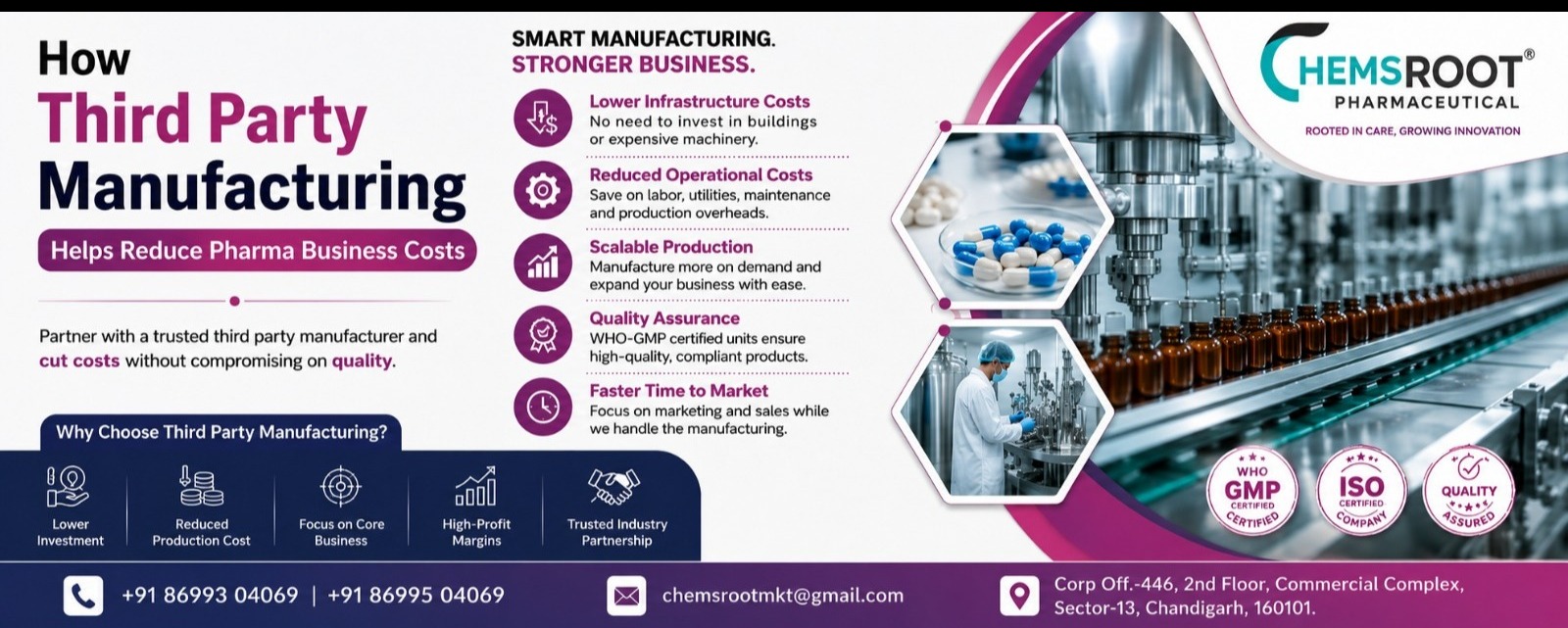
Establishing a pharmaceutical manufacturing facility requires substantial capital, infrastructure, equipment, technical staff, quality systems, maintenance, utilities, and regulatory management. How Third Party Manufacturing Helps Reduce Pharma Business Costs becomes clearer when these fixed commitments are compared with an outsourced production model.
For emerging pharma businesses in Chandigarh, third-party manufacturing can provide a way to focus resources on product selection, branding, distribution, and market development while production is handled by an external manufacturing facility.
It Reduces the Need for Manufacturing Infrastructure
Building a manufacturing plant requires far more than acquiring production machines.
Businesses may need land or premises, utilities, laboratory infrastructure, storage areas, production personnel, quality teams, maintenance systems, documentation processes, and ongoing facility management.
Outsourcing means a marketing company does not need to independently establish all this infrastructure solely to launch its portfolio.
Fixed Costs Can Become More Variable
Owning a facility creates expenses even when production demand is low.
With third-party manufacturing, expenditure is more closely connected with actual production orders. This can make the model attractive for companies that are building demand gradually.
It does not mean outsourced production has no fixed commitments. MOQ, packaging, artwork, inventory, freight, and working capital still require careful planning.
Businesses Can Access Multiple Product Categories
Creating separate manufacturing capabilities for tablets, liquids, creams, sachets, and injectables can require different infrastructure.
An outsourced model can allow marketers to explore multiple dosage forms through appropriate manufacturing partners without owning every production line themselves.
This can be particularly useful for Chandigarh-based companies building portfolios for several regional markets.
Inventory Planning Determines the Real Savings
Third-party manufacturing becomes inefficient when businesses over-order products that sell slowly.
Before confirming production, calculate:
- Expected monthly demand
- MOQ
- Inventory holding period
- Packaging cost
- Freight
- Storage requirements
- Payment cycle
- Expected distributor credit
The lowest manufacturing price is not automatically the lowest business cost.
Where Should the Savings Be Reinvested
Capital not committed to manufacturing infrastructure may potentially be allocated to areas such as distribution development, inventory management, compliant marketing activities, technology, staffing, and portfolio expansion.
The right allocation depends on the company's business model.
Chemsroot Pharmaceutical provides third-party manufacturing options for pharma businesses evaluating outsourced production from Chandigarh and other Indian markets. Commercial discussions should consider the complete cost structure rather than focusing only on the quoted unit rate.
Third-party manufacturing can reduce the need for heavy manufacturing investment, but disciplined business planning remains essential. The strongest cost advantage generally comes when outsourcing is combined with sensible MOQ selection, accurate demand forecasting, controlled inventory, and an efficient distribution strategy.
Keywords