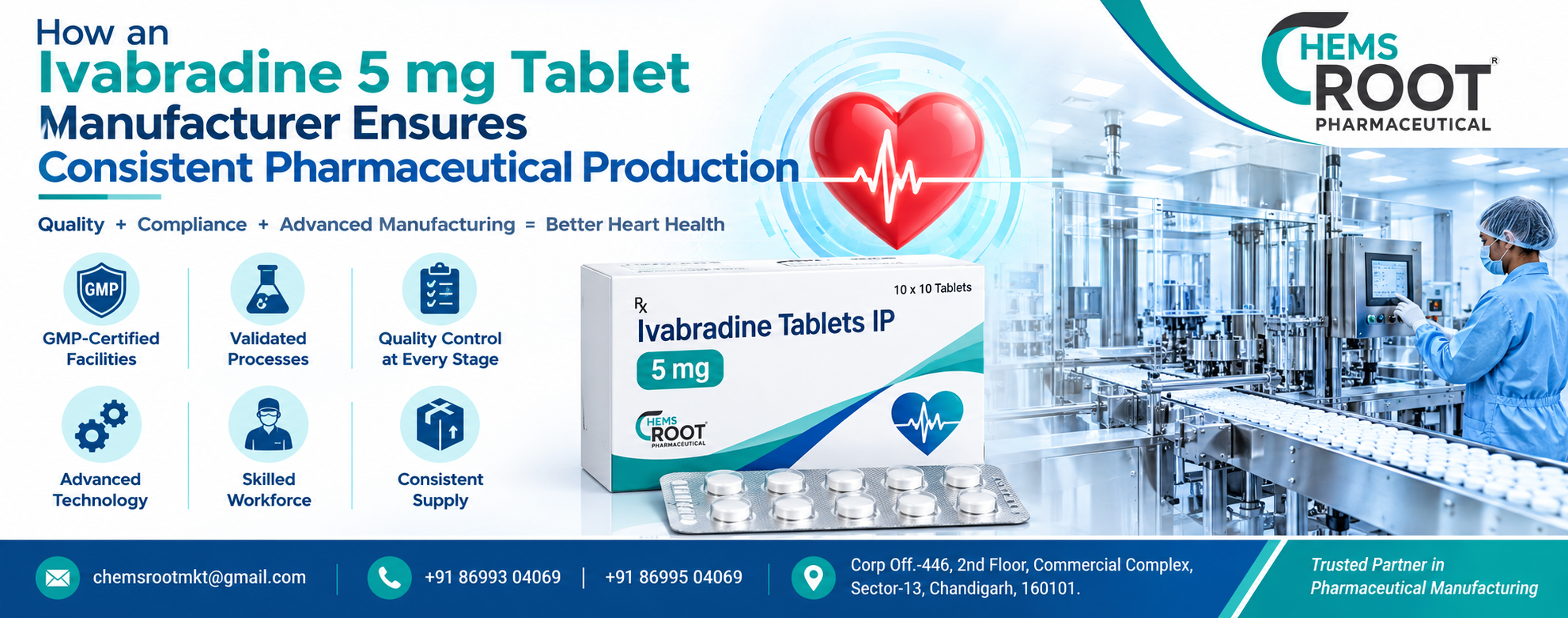
Consistency starts before compression: the manufacturer must control the low-dose ivabradine blend, verify every incoming material, and prove that the immediate-release tablet performs the same way from batch to batch. By the end, you will know which production steps, laboratory tests, records, and supplier documents demonstrate that a 5 mg batch is controlled rather than merely labelled correctly.
Key takeaways
- Define the tablet’s form, dimensions, colour, coating, and score before setting controls.
- Verify API identity, assay, impurities, and excipient quality before dispensing.
- Separate materials, labels, and equipment to prevent tablet mix-ups.
- Use dissolution, assay, content uniformity, stability, and validation records to confirm consistency.
Define the 5 mg Product Before Setting Process Controls
The target product must be defined as an immediate-release tablet before manufacturing controls are chosen. For an Ivabradine 5 mg tablet, the specification should state whether the dosage form is a film-coated tablet, its shape, dimensions, colour, debossing, coating finish, and whether it is scored.
A score line creates scored tablet validation risk: if patients may split it, the manufacturer must prove acceptable half-tablet mass and drug distribution; if splitting is not intended, the score must not imply it.
The product profile should establish these measurable attributes:
- Assay and content uniformity confirming each unit delivers the labelled 5 mg ivabradine strength, with the hydrochloride salt accounted for in the formula.
- Tablet weight, thickness, hardness, friability, and edge integrity, so tablets survive dedusting, coating, transport, and packaging without capping or breakage.
- Disintegration and dissolution limits that demonstrate rapid release from this immediate-release formulation, using a validated, discriminating method able to reveal changes in granulation, compression, or excipient performance.
- Appearance limits covering mottling, cracks, coating defects, imprint clarity, and colour variation.
- Related substances, water content, and stability requirements through the proposed shelf life and package configuration.
These attributes become critical quality attributes linked to compression force, lubrication, coating conditions, and other process parameters. Final assay alone cannot prove consistent production.
Qualify Ivabradine API and Excipients Before Dispensing
A low-dose tablet is only as reliable as the small amount of drug distributed through its blend. Incoming ivabradine hydrochloride API therefore remains quarantined until its identity, potency, impurity profile, and handling characteristics match approved specifications.
1. Review the supplier qualification file, manufacturing-site approval, audit history, change notifications, and certificate of analysis. Confirm that the lot number, retest or expiry date, container seals, storage conditions, and transport records match the delivery.
2. Take samples using an approved plan that covers the containers received, then perform API identity testing with a specific technique such as infrared spectroscopy. Do not release material because the supplier’s certificate looks complete; independently confirm the material is ivabradine hydrochloride.
3. Test assay and related substances against the registered specification. An incorrect salt, degraded lot, or excess process impurity can pass a basic appearance check while changing the dose delivered by each tablet.
4. Measure particle-size distribution, moisture, and flow-related properties. A coarse or highly cohesive API can segregate from the excipients, producing tablets with similar weight but different ivabradine content.
5. Qualify each excipient supplier and approve diluents, binders, disintegrants, and lubricants against material-specific specifications. Check identity, moisture, particle characteristics, density, and functional performance where those properties affect blending, compression, disintegration, or dissolution.
Only Quality Control can release the quarantined materials for dispensing. Any supplier, grade, site, or particle-size change needs documented impact assessment before use.
Control the Manufacturing Sequence and Prevent Product Mix-Ups
A single validated recipe cannot cover 5 mg, 7.5 mg, and prolonged-release products. Each strength and release type needs an approved master batch record, dedicated product status, and documented line clearance before materials enter the room.
The dispensing and sifting record identifies each material, lot, quantity, sieve, operator, and equipment. During blending, the manufacturer controls order of addition, mixing time, API particle-size distribution, excipient density, transfer distance, and hopper residence time. Blend uniformity samples then show whether low-dose ivabradine remains evenly distributed; tablet weight alone cannot prove that.
- Set compression force, turret speed, feeder speed, lubrication time, and dwell time within validated operating ranges.
- Monitor tablet weight, hardness, thickness, friability, disintegration, and appearance during compression.
- Reconcile issued, rejected, sampled, packed, and returned quantities before the batch moves forward.
- Use barcode or label verification for bulk containers, printed foil, cartons, and leaflets, with independent checks at each packaging line.
Product-specific controls must remain separate:
ProductBlend and compression controlPackaging control5 mg immediate-releaseProtect content uniformity and rapid disintegration; prevent segregation after lubrication and during hopper discharge.Verify the 5 mg strength, batch number, expiry date, and approved immediate-release artwork.7.5 mg immediate-releaseUse its own formula and validated compression range; never adjust the 5 mg settings by strength proportion.Use strength-specific line clearance and barcode checks.Prolonged-releaseControl matrix or coating parameters and dissolution; do not apply immediate-release settings.Segregate packaging materials and verify prolonged-release wording and strength.
Excessive lubrication or compression can leave assay acceptable while slowing release, so deviations require documented assessment before release.
Use In-Process Checks and Release Tests That Match the Formulation
For an immediate-release 5 mg film-coated tablet, proof requires both dosage accuracy and rapid release. Tablet weight variation is useful during compression, but it cannot replace content uniformity and dosage-unit uniformity: tablets with equal mass can contain different ivabradine amounts when blend segregation occurs.
The manufacturer should test or monitor:
- Blend uniformity before compression, then sample tablets across the beginning, middle, and end of the run to detect segregation during transfer, hopper discharge, or compression.
- Compression force, turret speed, feeder speed, lubrication time, dwell time, and tablet weight within established operating ranges. Over-lubrication or excessive compression can create hard, low-porosity tablets that pass assay but dissolve too slowly.
- Hardness and friability during compression. A tablet that is too weak may chip during coating or packing; excessive hardness can delay disintegration.
MeasurementWhat it provesFailure signalTablet weight variationCompression delivers consistent tablet massDrift suggests filling or flow problems, not necessarily wrong drug contentContent uniformity and dosage-unit uniformityIndividual tablets contain the labelled 5 mg strength within the approved acceptance criteriaUneven API distribution or segregationAssayThe batch contains the correct average ivabradine amountAverage strength is wrong even when individual tablets appear uniformDisintegrationThe immediate-release tablet breaks apart within its specified timeSlow breakup can delay drug availabilityDissolutionIvabradine releases at the intended rate and amountA passing assay with slow release indicates a formulation or compression defectHardness and friabilityTablets withstand handling without excessive damageCapping, abrasion, or coating loss
Release decisions should review these results together, not rely on final-tablet assay alone.
Verify Commercial Consistency Through Validation, Stability, and Records
Three successful qualification batches do not prove that commercial production remains controlled. Review process validation at commercial scale, then confirm continued process verification through dated trend reports for assay, content uniformity, dissolution, tablet weight, hardness, yield, and out-of-specification results.
Request these records before approving a contract batch:
- The approved product specification and master formula
- Batch manufacturing and packaging records for recent commercial lots
- Deviation, OOS, CAPA, complaint, and recall histories
- Traceability linking the ivabradine API lot and excipient lots to each finished batch
- Stability protocols, available results, and the manufacturer’s ongoing stability commitments
- GMP inspection reports, manufacturing authorisations, or current certification evidence
- Change-control records covering API suppliers, granulation equipment, compression tooling, coating systems, and primary packaging
A certificate of analysis cannot show gradual drift or an undocumented process change. Under ICH Q8, ask for the documented link between critical quality attributes and critical process parameters, not final-tablet assay alone.
Chemsroot Pharmaceutical should be able to define these records and access rights in a written quality agreement covering batch release, deviations, CAPA, changes, complaints, recalls, and regulatory communication.
Check stability evidence against the intended market and pack. ICH stability conditions include accelerated testing at 40°C ± 2°C and 75% RH ± 5% RH for six months for many room-temperature products; the long-term condition depends on the climatic zone.
A new pack or formulation change requires a documented assessment of comparability, dissolution, stability, and regulatory notification before routine use.
Related product
 Cardiodiabetic Range
Composition- Ivabradine 5mg Tablet
Frequently asked questions
- What must be defined before manufacturing an Ivabradine 5 mg tablet?
- Define it as an immediate-release tablet and document its coating, shape, dimensions, colour, debossing, finish, and scoring status.
- How are ivabradine API and excipients qualified before dispensing?
- Review approved supplier documents, confirm identity and quality results, and release each material against its specification before dispensing.
- How can manufacturers prevent mix-ups during ivabradine tablet production?
- Control the manufacturing sequence, segregate materials and labels, verify line clearance, and document equipment and batch identification.
- Which tests confirm consistent Ivabradine 5 mg tablets?
- Use in-process checks and release tests matched to the formulation, including appearance, weight variation, assay, content uniformity, and dissolution.
- How is commercial consistency verified over time?
- Use process validation, stability studies, completed batch records, deviation reviews, and trend analysis to confirm repeatable quality.
Keywords