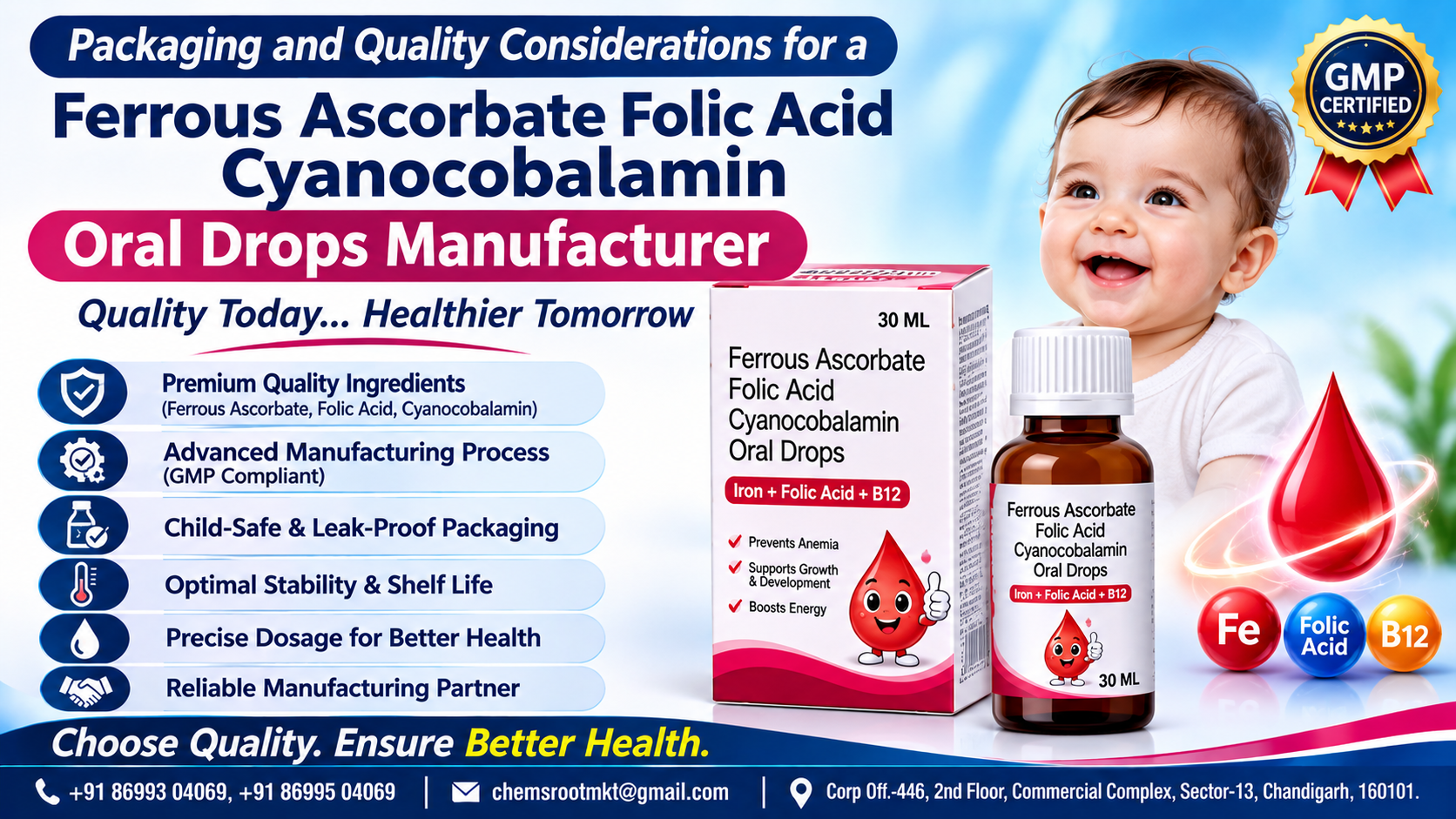
A buyer cannot compare iron oral drops safely by looking only at the product name or the weight of ferrous ascorbate on a quotation. You need to verify elemental iron per millilitre, dose-delivery accuracy, child-resistant packaging, opened-pack stability, and evidence that the formulation remains safe and uniform through its expiry period.
Key takeaways
- Calculate elemental iron delivered per mL before comparing suppliers.
- Check the bottle, closure and dropper for dose accuracy and compatibility.
- Request stability data for the opened, marketed pack.
- Verify release tests, licence documents and manufacturing controls before approval.
Start with the actual dose, label claim and patient fit
Approve the formulation only after converting the proposed ferrous ascorbate oral drops into the amount of elemental iron delivered in each mL. A label that states only the ferrous ascorbate salt strength cannot show whether two suppliers provide equivalent iron doses.
Set the intended dose against the actual patient group, not an average user. Confirm the target age or weight range, deficiency or supplementation purpose, daily administration volume and maximum daily exposure before fixing the label claim.
- State elemental iron per mL, not only the ferrous ascorbate quantity.
- State the folic acid strength per mL and the cyanocobalamin strength per mL in clear units, such as mg or micrograms.
- Define the measured volume that delivers one dose; do not express the dose in drops until the marketed dropper has demonstrated consistent delivery.
- Check that the proposed iron, folic acid and cyanocobalamin amounts fit the intended age group, clinical use and prescriber instructions.
- Require finished-product assays that distinguish each active from iron, ascorbate, flavour, colour, preservative and degradation products.
A narrow assay range does not prove dose quality if the analytical method counts degraded vitamin as active. Use a stability-indicating method and compare the initial and aged product for elemental iron, folic acid, cyanocobalamin, pH, precipitation and delivered dose.
If the formulation cannot deliver the declared amount throughout its stated use period, revise the strength or reject the proposal.
Treat the bottle and dropper as part of the medicine
Choose the bottle, closure and dropper as one dose-delivery system. The package must protect the drops, prevent unsafe access and deliver a repeatable volume from the first dose to the last.
An amber Type III glass bottle can reduce light exposure, while an HDPE or PET bottle may reduce breakage and weight. Neither material proves protection by itself: require compatibility and photostability data for the finished drops in the proposed bottle, dropper and secondary pack. Check for sorption, oxygen ingress, leakage and iron-related interaction.
Specify both safety features. A child-resistant closure is a primary requirement for iron-containing drops where poison-prevention rules apply, but caregivers must still open it without excessive force. A tamper-evident seal must show visible damage before first use and remain compatible with the closure and dropper.
Ask the manufacturer to verify:
- Delivered volume across the labelled range, repeatability, residual volume and performance at different orientations
- Dropper fit, leakage, graduated markings and compatibility with the bottle neck and liquid viscosity
- Dose uniformity at the beginning, middle and end of use, with shaking and resuspension instructions if sediment forms
| Packaging option | Main control to verify | Usability risk |
|---|---|---|
| Amber Type III glass | Light protection, breakage, closure fit and interaction data | Heavier and less resistant to impact |
| HDPE or PET bottle | Oxygen ingress, sorption, light transmission and leakage | Plastic alone does not establish photoprotection |
| Any marketed pack | In-use stability, microbial control and dose delivery | Bulk-liquid retain samples cannot reproduce package failures |
Retain finished product in the actual marketed container-closure system with its supplied dosing device, not bulk liquid alone. An in-use study must define the allowable period after opening.
Demand stability evidence for the opened, marketed pack
An unopened shelf-life result does not prove safety after opening. Require an in-use stability study using the marketed bottle, closure and dropper through the proposed use period, with repeated opening, dropper insertion, caregiver handling and room-temperature storage. State the allowable period after first opening; otherwise a caregiver cannot know when to discard it.
Ask for a protocol that measures:
- Ferrous-iron or elemental-iron assay, ferrous ascorbate content, ascorbate degradation and degradation products, rather than reporting only the salt assay.
- Folic acid and cyanocobalamin assay, pH, appearance, precipitation, sedimentation, caking and preservative content.
- Microbial quality at defined intervals, plus preservative efficacy testing on the final formulation in its marketed container.
- Delivered-dose uniformity at the beginning, middle and end of container use. For a suspension, document shaking or resuspension instructions; settling can make the first and last doses materially different.
The protocol should use ICH stability conditions suited to the intended market: long-term storage at 25°C/60% RH or 30°C/65% RH, and accelerated testing at 40°C/75% RH where justified. Hot, humid-market distribution needs more than room-temperature evidence.
Demand photostability data on finished drops in the immediate pack, including the dropper and any secondary carton relied on for protection. Amber glass or plastic alone proves nothing about light protection, while headspace and closure-permeability data address oxygen exposure that can affect cyanocobalamin, ascorbate and ferrous salts.
Check release tests, compatibility data and manufacturing controls
Approve a batch only when its records connect the validated commercial process to the marketed pack and finished-product specification. Request the approved master batch record, executed batch manufacturing and packing records, in-process results, deviation and out-of-specification investigations, equipment-cleaning records, and process-validation summary.
The certificate of analysis must identify the batch, methods, limits and actual results—not simply state “complies.”
Ask for these release and qualification records:
- Finished-product results for appearance, pH, fill volume, microbial limits, preservative content, and assay and related substances for ferrous ascorbate, folic acid and cyanocobalamin.
- Method-validation or method-suitability data proving that iron, ascorbate, flavour, colour, preservative and degradation products do not interfere with measurement.
- Container-closure integrity results, including the bottle, closure, seal and supplied dropper, plus dose-volume accuracy, repeatability, leakage, residual volume and orientation testing.
- Compatibility studies covering adsorption or absorption, oxygen and water-vapour transmission, light transmission, and extractables and leachables from plastic, elastomer, adhesive and glass components.
- Antimicrobial effectiveness testing against the specified challenge organisms, supported by preservative content and stability data in the actual pack.
- Retain-sample records for finished product in the marketed container-closure system with its dosing device; bulk liquid alone cannot reveal package-mediated oxidation, microbial ingress or dose-delivery failure.
| Record | Evidence to check | What a failure means |
|---|---|---|
| Stability | 25°C/60% RH or 30°C/65% RH long-term; 40°C/75% RH accelerated | Room-temperature data may not support hot, humid markets |
| Packaging | Integrity, compatibility and light protection throughout shelf life | Potency loss or leachables can occur behind an intact-looking bottle |
| Process | Validation, yield reconciliation and executed batch records | A passing final test cannot repair uncontrolled manufacture |
Use a supplier checklist before approving commercial production
Reject any proposal that cannot state elemental iron per millilitre, not merely the weight of ferrous ascorbate salt. Compare the formulation, container, dosing device, evidence package and total operating burden—not the quoted manufacturing price alone.
| Format | Dose control | Main risk | Evidence to request |
|---|---|---|---|
| Multidose dropper bottle | Convenient repeated dosing; drop volume must be fixed | Oxidation, microbial ingress, settling and dropper variability | In-use stability, delivered-dose data, closure compatibility and retain samples in the marketed pack |
| Unit-dose ampoules | Strong separation between doses; no repeated bottle opening | Higher packaging, filling and disposal burden | Fill-volume controls, seal-integrity testing and transport qualification |
| Multidose bottle with oral syringe | Graduated volume supports larger or variable doses | Syringe–bottle mismatch, residual liquid and caregiver errors | Syringe accuracy, adapter compatibility, usability and dose-recovery data |
Ask every contract manufacturer for:
- A component specification naming bottle material, colour, capacity, closure, tamper-evident seal and child-resistant feature, plus the dropper or oral syringe model.
- A stability protocol covering elemental iron, ferrous ascorbate, ascorbate degradation, folic acid, cyanocobalamin, pH, preservative content, microbial quality, appearance, sedimentation and delivered dose after opening.
- A batch manufacturing record, process-validation summary, filling-line controls, deviation history and certificate of analysis for representative batches.
- Retain samples of finished product in the actual container-closure system with the supplied dosing device; bulk liquid alone is inadequate.
Chemsroot Pharmaceutical can be compared on this same evidence checklist when its oral-drops proposal is reviewed, rather than being selected from catalogue composition or dosage form alone.
Frequently asked questions
Why must you calculate elemental iron per mL?
Ferrous ascorbate salt strength does not show the actual iron dose. Convert the proposed strength into elemental iron delivered in each mL before comparing suppliers or approving the label claim.
Why are the bottle and dropper part of the medicine?
The container and dropper control dose delivery, protect the formulation and affect contamination risk. Check graduations, delivered volume, closure fit, material compatibility and dropper performance.
What stability evidence should a manufacturer provide?
Request stability data for the filled, marketed pack, including results after opening. Review assay, appearance, pH, degradation, microbial quality and dose delivery across the labelled storage period.
Which documents and tests should you check before commercial production?
Review the product specification, assay and content-uniformity results, microbial limits, preservative testing where relevant, compatibility studies, batch records, change controls and the manufacturer’s licence documents.
Keywords