
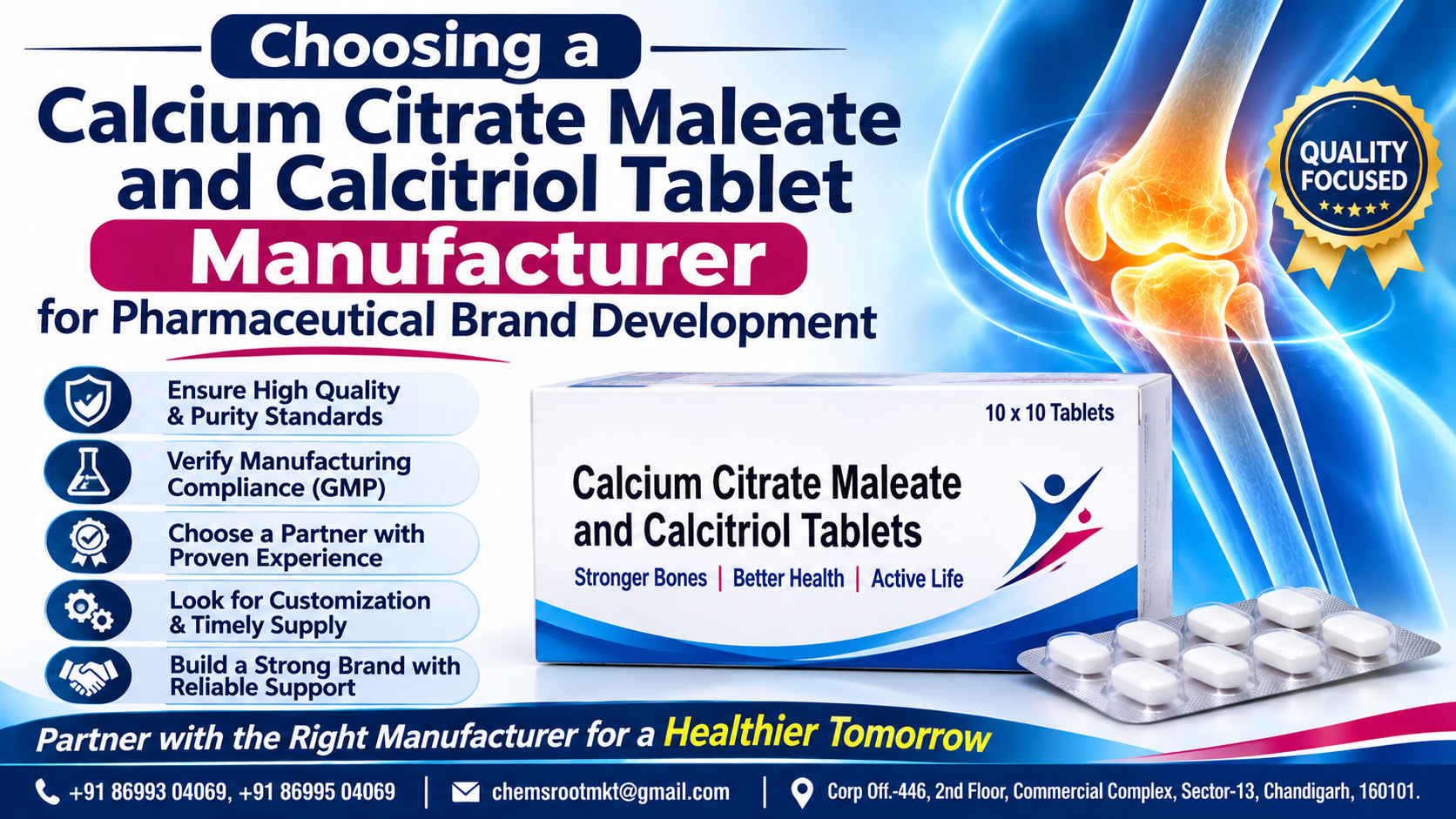
A proposed calcium citrate maleate and calcitriol tablet needs more than a credible product name: you must confirm the calcium salt, elemental calcium, vitamin D ingredient, low-dose controls, and stability evidence. By the end, you can compare manufacturers using a product-specific technical, regulatory, quality, and commercial checklist instead of relying on a catalogue or generic GMP certificate.
Key takeaways
- Confirm the formulation names calcium citrate maleate and calcitriol explicitly.
- Compare elemental calcium and calcitriol strength per tablet, not ingredient weights alone.
- Request assay and content-uniformity evidence for the low calcitriol dose.
- Review stability data, packaging specifications, raw-material records, and GMP documentation.
Confirm the calcium salt and vitamin D ingredient before comparing suppliers
The proposed product is confirmed only when its formulation sheet names both the calcium compound and vitamin D ingredient, not merely “calcium with vitamin D.” Require the supplier to resolve whether it means calcium citrate maleate or calcium citrate malate; do not treat those names as interchangeable without a defined material specification.
1. Request the master formula, product specification, and certificate of analysis for the calcium salt. They must state the salt identity, assay basis, elemental calcium contribution per tablet, excipient system, and permitted assay range. Salt weight alone is not the calcium dose.
2. Verify the vitamin D ingredient as calcitriol, not cholecalciferol, ergocalciferol, or another analogue. Record the exact strength, unit presentation, supplier or grade, overage policy, and finished-tablet assay limit. A low-dose calcitriol product requires tighter controls than a routine supplement.
3. Check the proposed label, master batch record, and analytical method against one another. The declared elemental calcium and calcitriol amount must match across all three documents.
4. Put identity controls in the quality agreement. Require written approval for changes to the calcium source, calcitriol grade, assay method, excipients, tooling, coating, packaging, or manufacturing site.
Material namedWhat you must confirmCalcium citrate maleateExact chemical identity and elemental calcium per tabletCalcium citrate malateWhether this is the intended CCM material, not an assumed synonymCalcium citrateSeparate salt specification; do not use it as a substituteCalcium carbonate comparisonCompare elemental calcium and finished-product performance, not salt weight alone
Compare elemental calcium, calcitriol strength, and dose-control requirements
The number that matters for calcium is the elemental calcium per tablet, not the milligrams of calcium citrate maleate powder. Require the formulation sheet to show salt weight, calcium assay basis, excipients, and the exact elemental calcium contribution; a larger salt weight does not necessarily deliver more calcium.
ComponentCompare on the formulation sheetWhat should concern youCalcium citrate maleateSalt weight, elemental calcium per tablet, assay basis, and excipient systemCCM presented as interchangeable with calcium citrate or calcium carbonateCalcitriolStrength and unit, such as micrograms per tablet; overage policy and permitted assay range“Vitamin D” stated without a named ingredient or doseCholecalciferol versus calcitriolIngredient identity, stability plan, monitoring implications, and prescribing useCholecalciferol substituted for calcitriol without a documented product change
Ask the manufacturer to reconcile the salt weight with the labelled calcium amount using its calculation and assay data. Reject a sheet that reports only total calcium salt or a percentage without the per-tablet elemental value.
Calcitriol demands tighter dose control than an ordinary calcium supplement because a very small quantity must be distributed through the blend. Require blend-uniformity data, individual finished-tablet content uniformity under USP <905>, and the permitted assay range—not only an average assay.
The supplier’s validated method should demonstrate specificity against calcium salts and excipients, accuracy at the low concentration, precision, linearity, solution stability, and a stated limit of quantitation for degradation products.
Demand proof that every tablet receives the intended low calcitriol dose
An average calcitriol assay can pass while individual tablets contain too little or too much of this potent, low-dose ingredient. Do not accept a batch certificate showing only mean assay; require evidence that the manufacturing process distributes calcitriol consistently from the first blend through the finished tablet.
Ask the manufacturer for:
- A process-validation report identifying the calcitriol addition step, mixing time, equipment, sampling locations, and acceptance limits for blend uniformity.
- Raw blend-uniformity results, including individual sample values and the analytical method used, not only a statement that the blend passed.
- Finished-tablet content uniformity results from samples across the compression run. The evaluation should follow USP <905>; a passing average assay does not replace dosage-unit testing.
- A calcitriol assay validation report covering specificity against calcium salts and excipients, accuracy at the product’s low concentration, precision, linearity, solution stability, and the limit of quantitation for degradation products.
- The validated related-substances method, chromatograms, system-suitability criteria, and representative stability results so degradation is not mistaken for active ingredient.
- Batch records showing controls for geometric dilution, equipment cleaning, compression start-up, tablet weight, and segregation. These controls reveal whether the validated blend actually reaches commercial production.
The quality agreement must require advance assessment and approval of changes to the calcitriol supplier or grade, excipients, assay method, compression tooling, coating, packaging, and manufacturing site. Each change needs an impact assessment covering product quality, regulatory status, and the validation state; otherwise a uniform pilot batch offers little assurance about future supply.
Review raw-material qualification, stability data, packaging, and GMP records
Approve the site only after reviewing product-specific evidence; a GMP certificate alone does not qualify a calcium citrate maleate–calcitriol product. Ask for recent inspection history, the proposed master batch record, and controlled records showing how deviations, CAPA, change control, and data integrity are managed.
Request these documents:
- Raw-material files: certificate of analysis for each calcium and calcitriol lot, approved specifications, supplier qualification, test methods, and impurity limits.
- Stability protocol and reports from ICH Q1A(R2) stability studies in the proposed market container-closure system, covering assay, degradation products, dissolution, appearance, moisture, and microbiological attributes where relevant.
- A validated calcitriol assay and related-substances method showing specificity, low-level accuracy, precision, linearity, solution stability, and the limit of quantitation.
- Packaging specifications and evidence that the proposed blister or bottle protects against identified moisture and light risks.
- The quality agreement defining batch release, complaints, recalls, regulatory submissions, and approval of changes to suppliers, excipients, methods, tooling, packaging, or site.
EvidenceInspect forWhat failure indicatesSite GMP recordInspection findings and CAPA closureA certificate may conceal unresolved system weaknessesBatch documentationExecuted records, deviations, and reconciliationIncomplete traceability or uncontrolled process changesStability packageLong-term, accelerated, and intermediate data when requiredAn expiry date based only on accelerated resultsQuality agreementNamed responsibilities and change notification timelinesDisputes during release, recall, or export
Agree export documents before production, including the batch-specific certificate of analysis, certificate of pharmaceutical product where required, legalized GMP evidence, product information, and destination-country labelling.
Convert technical evidence into a defensible brand and supply decision
Approve a manufacturer only when the product evidence and the contract support the same claim. For Indian distribution, require alignment with Indian pharmacopoeial standards, the approved formulation, validated calcitriol methods, and the proposed market pack. A GMP certificate alone does not qualify this product.
For a supplier such as Chemsroot Pharmaceutical, treat a catalogue listing as a starting point, not proof that the proposed calcium citrate maleate product exists at the required strength.
Put these controls in the quality agreement:
- Define who approves the master batch record, releases each batch, investigates deviations, manages CAPA, answers complaints, and initiates recalls.
- Require written change control before changing the calcium source, calcitriol supplier or grade, assay method, excipients, compression tooling, coating, packaging, or manufacturing site.
- Require an impact assessment covering product quality, regulatory status, validation, stability, and the need for customer or authority approval.
- Set data-integrity expectations for laboratory records, electronic systems, raw data, and retention periods.
Agree the export dossier before production. Depending on the destination, specify the certificate of pharmaceutical product, legalized GMP or manufacturing certificates, batch-specific certificate of analysis, stability data, product information, and country-specific labelling. A certificate of pharmaceutical product is not interchangeable with a batch certificate.
Name the approved container-closure system in the contract. Switching from an alu-alu blister to an HDPE bottle triggers stability assessment for moisture and light protection; it is not merely a packaging redesign. Reject suppliers that cannot provide these documents, timelines, and change notifications in writing.
Frequently asked questions
- What must the formulation sheet identify before supplier comparison?
- It must name the calcium compound and vitamin D ingredient, including whether the material is calcium citrate maleate or calcium citrate malate and the defined specification for each.
- How should you compare calcium and calcitriol tablet strengths?
- Compare elemental calcium per tablet, calcitriol strength per tablet, serving size, and dose-control data rather than comparing the total weight of calcium compounds.
- What evidence proves consistent delivery of a low calcitriol dose?
- Request assay results, content-uniformity testing, analytical-method details, batch records, and release specifications showing that each tablet receives the intended calcitriol amount.
- Which supplier records should you review before approving a manufacturer?
- Review raw-material qualification, certificates of analysis, accelerated and long-term stability data, packaging specifications, GMP records, manufacturing licences, and change-control procedures.
Keywords