
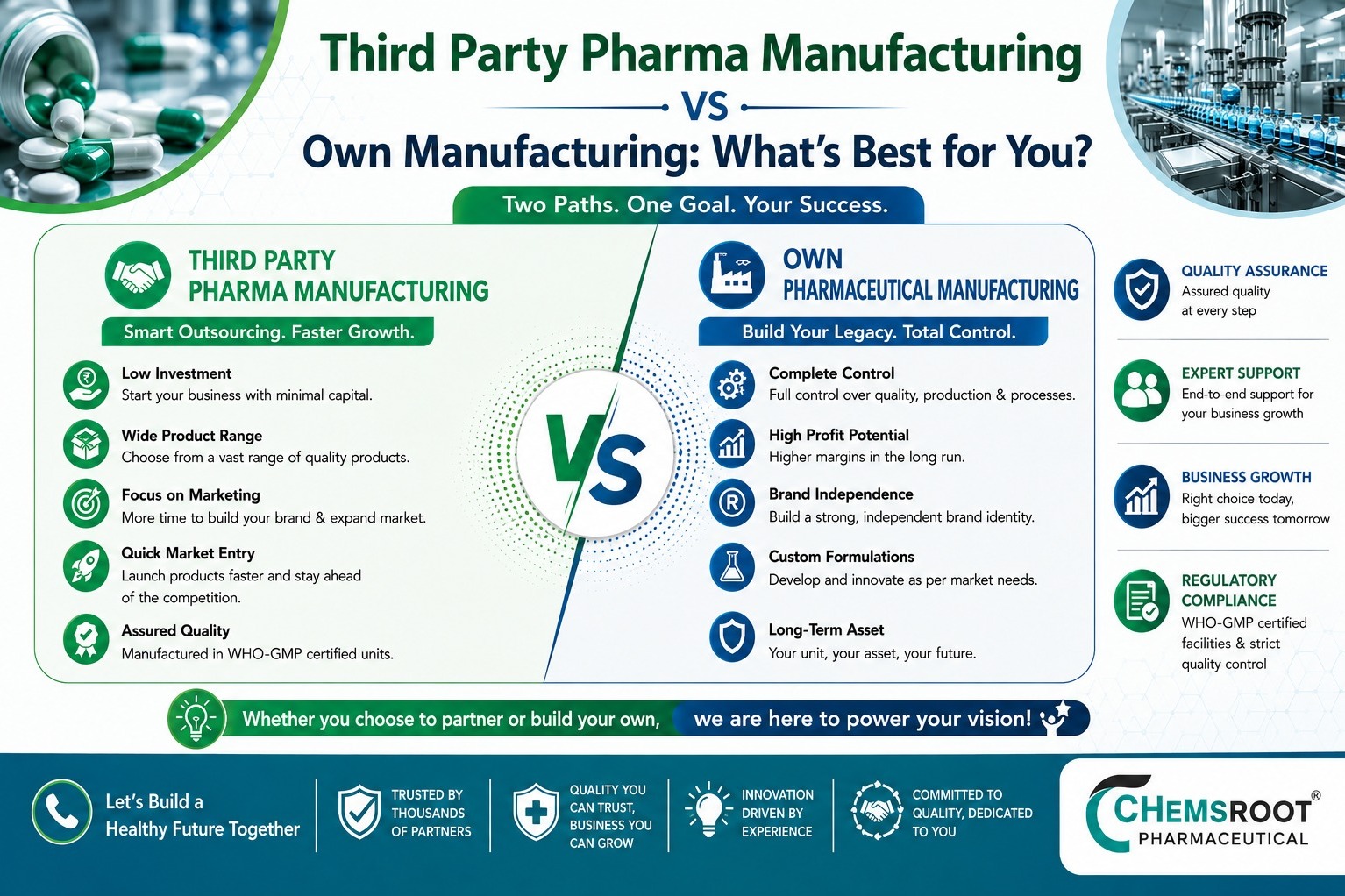
When launching a pharmaceutical brand or expanding an existing product portfolio, one of the first strategic decisions is whether to establish your own manufacturing unit or partner with a third-party pharmaceutical manufacturer. Both approaches have their advantages, but the right choice depends on your business goals, investment capacity, regulatory readiness, and long-term plans.
For many pharma distributors, healthcare entrepreneurs, hospitals, and medical representatives across Chandigarh and other parts of India, third-party manufacturing has become a practical way to enter the pharmaceutical market without investing heavily in production infrastructure.
Understanding Own Pharmaceutical Manufacturing
Own manufacturing involves setting up and operating a pharmaceutical production facility. This includes acquiring land, installing machinery, obtaining regulatory approvals, hiring qualified personnel, maintaining quality systems, and managing production schedules.
This model gives businesses complete control over manufacturing operations, product development, and production planning. However, it also demands significant capital investment and continuous compliance with pharmaceutical regulations.
Businesses choosing this route should be prepared for:
- High infrastructure costs
- Manufacturing licenses and regulatory approvals
- Skilled technical workforce
- Equipment maintenance
- Quality assurance and testing laboratories
- Inventory management
- Ongoing operational expenses
While this approach may suit large pharmaceutical companies, it can be challenging for startups and growing businesses.
What Is Third Party Pharma Manufacturing?
Third-party pharmaceutical manufacturing allows a company to market medicines under its own brand while an established manufacturer handles production according to approved specifications.
The client focuses on branding, marketing, distribution, and sales, while the manufacturer manages production, quality testing, packaging, and regulatory compliance.
Many pharmaceutical businesses prefer this model because it significantly reduces operational complexity.
Comparing Third Party Manufacturing and Own Manufacturing
Choosing between the two models becomes easier by evaluating key business factors.
Investment
Own manufacturing requires a substantial upfront investment in infrastructure, machinery, utilities, and workforce.
Third-party manufacturing requires comparatively lower investment since production facilities are already available with the manufacturer.
Time to Market
Building a manufacturing unit can take months or even years before commercial production begins.
Third-party manufacturing enables businesses to introduce products much faster because manufacturing systems are already operational.
Regulatory Compliance
Operating a pharmaceutical plant requires ongoing compliance with GMP standards, audits, documentation, and quality management.
With third-party manufacturing, much of the production compliance is handled by the manufacturing partner, simplifying operations for the client.
Product Expansion
Launching new formulations through an in-house facility often requires additional equipment and process validation.
Third-party manufacturers usually offer extensive product portfolios, making it easier to expand into multiple therapeutic categories.
Which Businesses Benefit Most from Third Party Manufacturing?
This model is often suitable for:
- Pharma distributors
- PCD pharma franchise companies
- Medical representatives starting their own business
- Healthcare entrepreneurs
- Hospital procurement teams
- Pharmacy chains
- Generic medicine marketers
- Regional pharmaceutical companies
Instead of investing in manufacturing infrastructure, these businesses can focus on market development and customer relationships.
Why Quality Matters
Regardless of the manufacturing model, product quality should always remain the top priority.
Before selecting a manufacturing partner, businesses should evaluate:
- Manufacturing certifications
- Quality control procedures
- Batch testing protocols
- Packaging standards
- Production capacity
- Delivery timelines
- Documentation support
A reliable manufacturing partner helps maintain consistency across every production batch.
The Chandigarh Advantage
Chandigarh has emerged as an important pharmaceutical business hub because of its proximity to established pharma manufacturing clusters in North India. Businesses operating in Punjab, Haryana, Himachal Pradesh, Delhi NCR, and neighboring states often prefer working with manufacturers in this region for efficient logistics and supply chain management.
Companies such as Chemsroot Pharmaceutical support pharmaceutical businesses by offering third-party manufacturing services across a broad range of formulations, allowing clients to focus on building their brands while production is handled by experienced manufacturing teams.
Making the Right Decision
The decision between own manufacturing and third-party manufacturing depends on your available resources, business objectives, and expansion plans.
If your goal is to establish manufacturing infrastructure and maintain complete production control, owning a facility may be appropriate despite the higher investment and operational responsibilities.
If your priority is faster market entry, lower investment, wider product availability, and operational flexibility, third-party pharmaceutical manufacturing is often the more practical choice. Before making a decision, assess your expected product volumes, target markets, compliance requirements, and long-term growth strategy to select a manufacturing model that aligns with your business goals.