
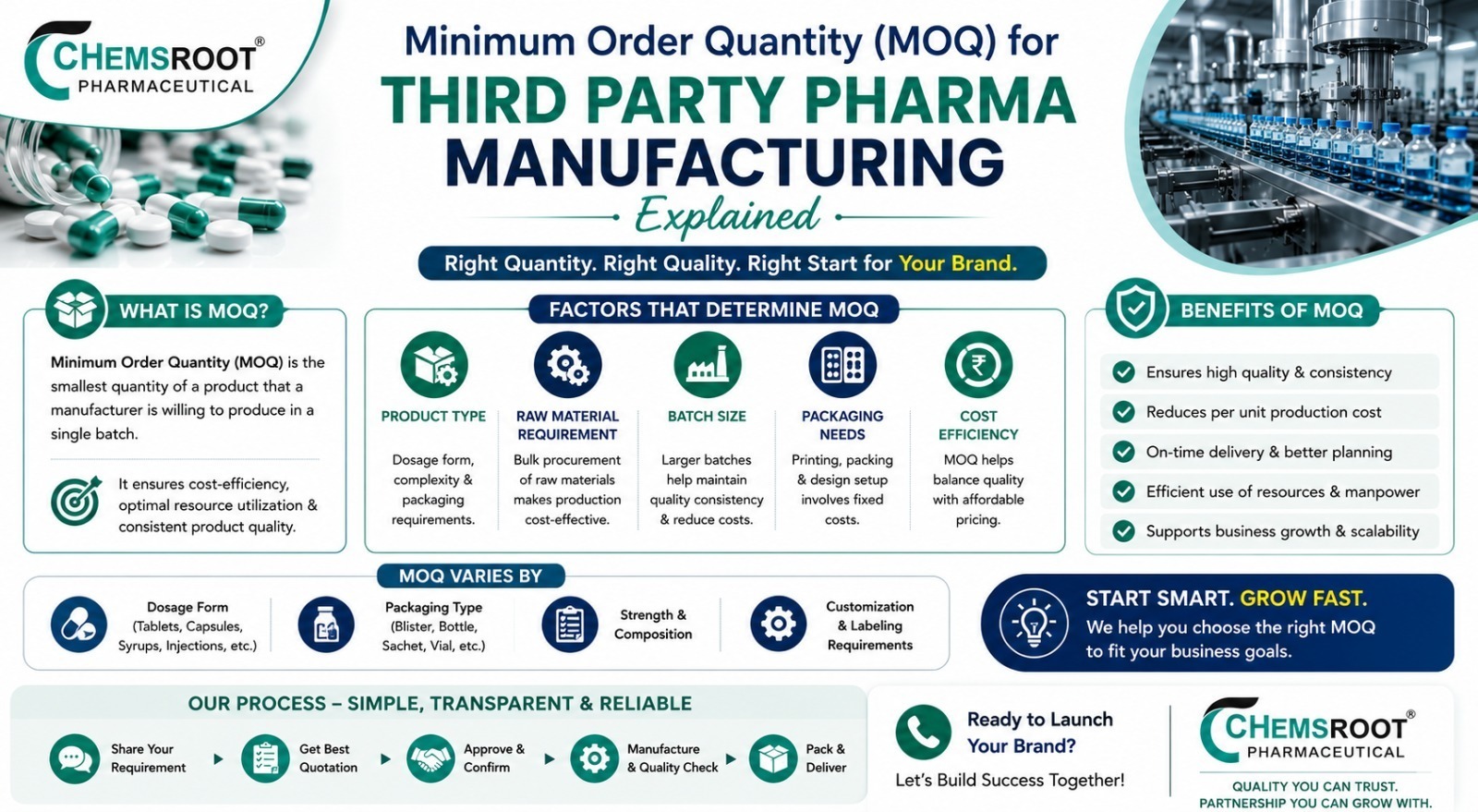
When a pharma company plans to outsource production, one of the first practical questions is how much stock must be ordered. Minimum Order Quantity (MOQ) for Third Party Pharma Manufacturing Explained helps pharma distributors, new brands, and healthcare entrepreneurs understand why manufacturers set minimum production quantities and how those quantities affect investment and inventory planning.
For businesses operating from Chandigarh and serving markets across Punjab, Haryana, Himachal Pradesh, and other parts of India, understanding MOQ before finalising a product range can prevent excess inventory and unexpected manufacturing costs.
What Does MOQ Mean in Pharma Manufacturing
MOQ is the minimum quantity of a particular pharmaceutical product that a manufacturer can accept for a production order.
There is no single MOQ applicable to every medicine. The practical quantity can depend on:
- Dosage form
- Formulation and strength
- Manufacturing batch size
- Raw-material requirements
- Packaging configuration
- Printed packaging quantities
- Production-line capacity
A tablet, syrup, capsule, ointment, sachet, and injectable may therefore have very different minimum production requirements.
Why Manufacturers Cannot Always Produce Very Small Quantities
Every pharmaceutical batch requires several activities regardless of whether the buyer needs a small or large commercial quantity. These can include material procurement, dispensing, equipment preparation, manufacturing, testing, packaging, documentation, and production-line cleaning.
Producing an extremely small quantity may therefore be commercially or technically impractical.
Packaging can create another limitation. Custom-printed cartons, labels, foils, and other materials may themselves have minimum printing quantities.
How Should a Pharma Business Calculate Its Requirement
Ordering the maximum possible quantity is not necessarily economical.
A business should consider expected monthly sales, distributor demand, working capital, expiry period, storage capacity, and the number of formulations being launched.
For example, launching 30 products simultaneously at unnecessarily high quantities could lock substantial capital into inventory. A carefully selected initial portfolio may provide better stock movement and cash-flow flexibility.
Questions to Ask About MOQ
Before confirming production, clarify:
- Is the MOQ calculated per formulation?
- Does changing the strength create a separate MOQ?
- What pack sizes are available?
- Are printed packaging quantities different from production quantities?
- What happens to unused packaging material?
- Are repeat-order quantities the same?
- What is the estimated production lead time?
Chemsroot Pharmaceutical works with pharma businesses exploring third-party manufacturing requirements from Chandigarh and other Indian markets. Discussing formulation-specific quantities before placing an order helps both sides establish realistic production expectations.
MOQ should ultimately be viewed as an inventory-planning factor rather than simply a manufacturer's restriction. When production quantity is aligned with market demand, working capital, and expected sales velocity, third-party manufacturing can become considerably easier to manage.