
One of the first questions businesses ask before outsourcing pharmaceutical production is, 'What is the minimum order quantity?' Whether you are a new PCD pharma franchise company, a distributor launching a private label, or an established healthcare business expanding its portfolio, understanding MOQ helps you plan inventory, investment, and market entry more effectively.
For businesses working with third-party pharmaceutical manufacturers in Chandigarh and across India, MOQ is more than just a number—it is a factor that influences production efficiency, packaging, procurement, and overall project cost.
What Is Minimum Order Quantity in Pharma Manufacturing?
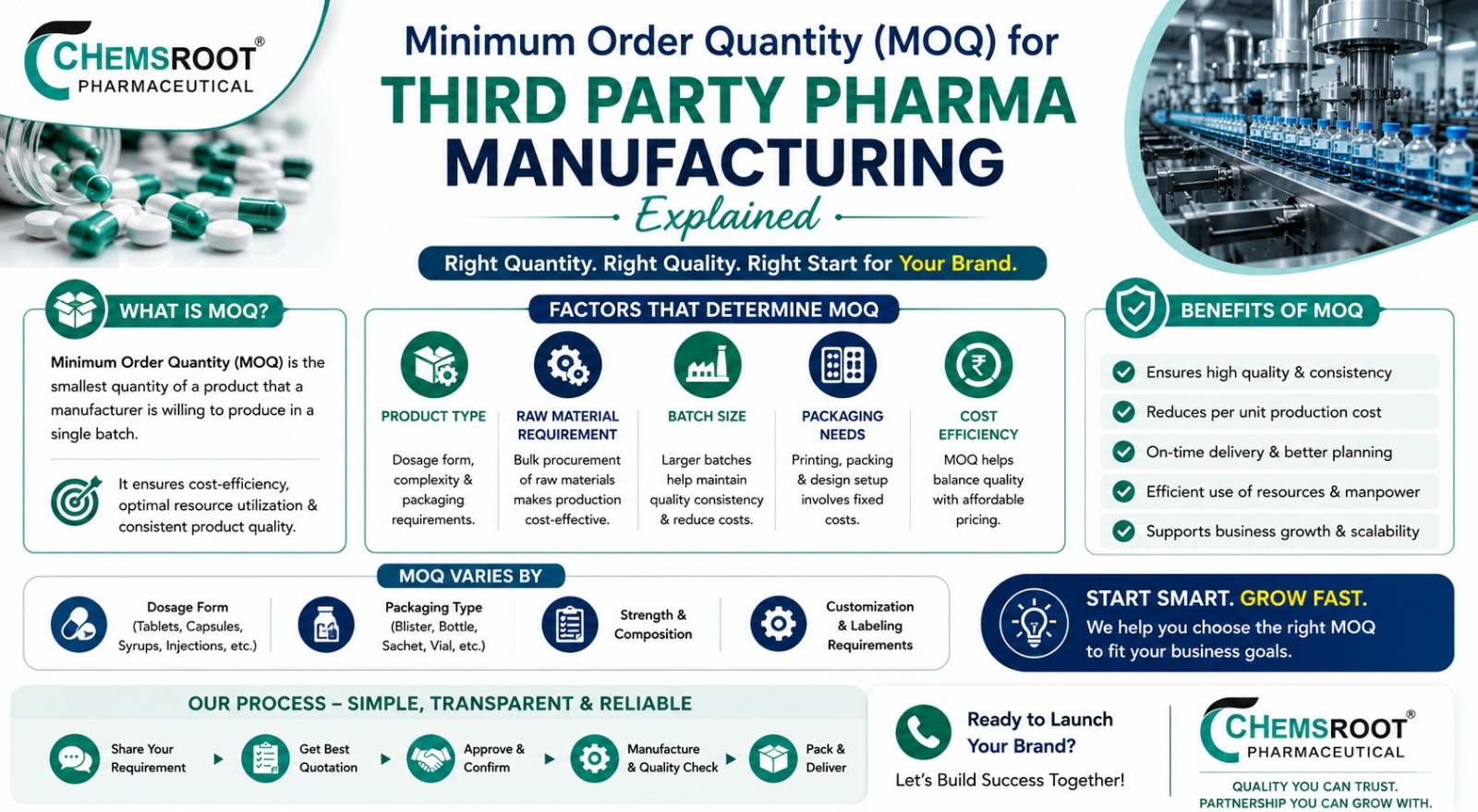
Minimum Order Quantity (MOQ) refers to the smallest quantity of a product that a manufacturer agrees to produce in a single production batch.
Unlike general consumer products, pharmaceutical manufacturing involves regulated production processes, validated equipment, laboratory testing, packaging materials, and quality documentation. Producing very small quantities often becomes commercially impractical because many production costs remain the same regardless of batch size.
Each formulation may have a different MOQ depending on its dosage form and packaging requirements.
Why Do Pharmaceutical Manufacturers Have MOQ Requirements?
Minimum order quantities are established for several practical reasons.
Some of the most common include:
- Efficient utilization of production lines
- Cost-effective procurement of raw materials
- Standardized quality control procedures
- Packaging material optimization
- Reduced manufacturing wastage
- Better production scheduling
Maintaining a reasonable batch size allows manufacturers to keep production efficient while ensuring consistent product quality.
Factors That Affect MOQ
There is no universal MOQ for every pharmaceutical product. Several variables influence the quantity required.
Type of Formulation
Products such as tablets, capsules, syrups, injections, creams, ointments, lotions, and nutraceuticals often have different production requirements.
Packaging Configuration
Blister packs, bottles, jars, tubes, sachets, and customized cartons may require different minimum production volumes because packaging materials are often produced in bulk.
Product Complexity
Specialized formulations with unique ingredients or advanced manufacturing processes may require larger production quantities than commonly manufactured products.
Custom Branding
Private labeling with customized artwork, printed foils, cartons, inserts, and labels can also influence MOQ because printing vendors typically have minimum production requirements.
How Businesses Can Plan Around MOQ
Rather than viewing MOQ as a limitation, businesses can use it as a planning tool.
Consider these strategies:
- Launch a focused product portfolio initially.
- Prioritize medicines with higher market demand.
- Estimate projected sales before placing an order.
- Maintain adequate inventory without excessive stock.
- Expand gradually based on market response.
This approach reduces financial risk while supporting sustainable business growth.
Is Lower MOQ Always Better?
Many startups assume that lower MOQ automatically offers greater flexibility. However, very small production quantities may increase the manufacturing cost per unit because production overheads are distributed across fewer products.
In many cases, a balanced order size provides better pricing while ensuring sufficient inventory to meet customer demand.
Businesses should evaluate both order quantity and long-term sales potential instead of focusing solely on the lowest possible MOQ.
Choosing a Manufacturer That Offers Flexibility
Before selecting a third-party manufacturer, discuss:
- Product-wise MOQ
- Future scalability
- Pricing structure
- Packaging flexibility
- Repeat order process
- Production timelines
A manufacturer willing to explain these factors transparently can make inventory planning much easier.
Chandigarh's Growing Role in Third-Party Manufacturing
Chandigarh has become a preferred destination for pharmaceutical outsourcing because of its strong connectivity with major pharma markets across North India. Businesses from Punjab, Haryana, Himachal Pradesh, Rajasthan, Delhi NCR, and neighboring regions often choose manufacturers here for reliable logistics and production support.
Chemsroot Pharmaceutical works with businesses seeking third-party manufacturing solutions across multiple therapeutic categories. The company discusses MOQ requirements based on individual formulations so clients can make informed production decisions rather than relying on generalized estimates.
Planning Orders for Sustainable Growth
Minimum Order Quantity should be viewed as part of an effective business strategy rather than an obstacle. Understanding how MOQ relates to production efficiency, pricing, and inventory management helps businesses make smarter purchasing decisions. By selecting products carefully, forecasting demand realistically, and working with an experienced manufacturing partner, pharmaceutical businesses can build a scalable product portfolio while maintaining healthy inventory levels and controlled investment.